Searching for useful collection letters samples that can be personalized quickly? This collection includes 10 or more practical examples created to communicate the purpose clearly, add useful context, and guide the recipient toward the intended response. Rather than offering empty filler, the templates help you introduce the subject directly, establish the necessary context, and make the purpose clear to readers from the opening lines.
These examples can be adapted by individuals, employees, businesses, schools, organizations, and community groups. A complete letter may need the recipient, reason for writing, dates, supporting facts, requested action, and contact details. Select the version closest to your circumstances, then replace every placeholder and broad claim with accurate names, dates, facts, and expectations. Specific information improves clarity, credibility, and relevance while reducing the risk of delay or misunderstanding.
Start by identifying the result you want and gathering the details that support it. Compare the preview images below, choose the most suitable downloadable template, and revise its wording for your audience and level of formality. Remove anything that does not apply, check grammar and factual accuracy, confirm attachments and contact information, and retain a copy of the final letter for future reference.
What Is a Collection Letter?
A collection letter is a written communication sent to request payment of money that is due or overdue. Businesses often send a series of collection letters as an account becomes increasingly delinquent.
For example, a company may first send a friendly payment reminder shortly after an invoice becomes overdue. If payment is still not received, the business may send a more formal collection notice explaining the outstanding balance and a deadline for payment.
A collection letter may be used for:
- Unpaid invoices
- Overdue customer accounts
- Outstanding balances
- Late payments
- Unpaid services
- Unpaid products or orders
- Business debts
- Loan or credit payments
- Rent or other contractual payments
- Final payment demands
- Accounts requiring further collection action
Why Use a Collection Letter?
A collection letter creates a written record of the payment request and gives the recipient an opportunity to resolve the outstanding account.
A professional collection notice can help you:
- Remind customers about overdue payments
- Clearly identify the amount owed
- Reference an invoice or account number
- Provide a payment deadline
- Explain available payment methods
- Encourage prompt payment
- Offer an opportunity to discuss a payment problem
- Document previous communication
- Reduce misunderstandings about an account
- Communicate the next step if payment is not received
A collection letter should be viewed as a professional business communication rather than simply a demand for money. Maintaining a respectful tone can help preserve a valuable customer relationship while still communicating the importance of timely payment.
How to Write a Collection Letter
The exact wording depends on the type of debt and the relationship between the sender and recipient, but most effective collection letters include the following information.
1. Add the Date
Include the date the letter is being issued. This establishes when the payment request was communicated and makes the correspondence easier to track.
2. Identify the Recipient
Use the recipient’s correct name and address. If the letter is being sent to a company, include the appropriate department or accounts-payable contact when known.
3. Reference the Account or Invoice
Clearly identify the account, invoice, order, contract, or other document associated with the payment.
For example:
Invoice Number: INV-1058
Invoice Date: March 10, 2026
Amount Due: $2,500
Due Date: April 9, 2026
This makes it easier for the recipient to verify the debt.
4. State the Outstanding Amount
Clearly state the balance that remains unpaid. Avoid making the recipient search through several paragraphs to determine how much is owed.
5. Explain When Payment Was Due
Mention the original due date and, where appropriate, how many days the account is past due.
6. Request Payment
Clearly explain what action you want the recipient to take. Include a specific payment deadline when appropriate.
7. Provide Payment Instructions
Tell the recipient how payment can be made, such as by bank transfer, check, online payment, or another approved method.
8. Provide Contact Information
Give the recipient a phone number, email address, or accounts-receivable contact for questions, disputes, or payment arrangements.
9. Explain the Next Step Carefully
If your agreement, contract, or applicable law permits further collection action, the letter may explain what could happen if the account remains unpaid.
Avoid making threats or claiming legal consequences that you are not legally entitled to pursue.
Collection Letter Format
A standard collection letter format can look like this:
[Date]
[Recipient Name]
[Company Name]
[Address]
Subject: Payment Reminder for Outstanding Account [Account/Invoice Number]
Dear [Recipient Name]:
This letter is a reminder that your account with [Company Name] has an outstanding balance of [Amount]. According to our records, the payment was due on [Due Date].
Please arrange payment of the outstanding amount by [Payment Deadline]. Payment can be made by [Payment Method].
If you have already submitted payment, please disregard this notice. If there is an issue with the invoice or account, please contact [Name/Department] at [Phone/Email] so that we can review the matter.
Thank you for your prompt attention to this account.
Sincerely,
[Name]
[Job Title]
[Company Name]
[Contact Information]
Types of Collection Letters
Invoice Payment Collection Letter
An invoice payment collection letter reminds a customer that an invoice has not yet been paid. Include the invoice number, invoice date, amount due, payment terms, and payment deadline.
Outstanding Payment Letter
An outstanding payment letter is used when a customer has an unpaid balance. It can be written as a polite reminder or as a more formal payment demand depending on how long the account has been overdue.
Overdue Invoice Letter
An overdue invoice letter specifically addresses an invoice that has passed its due date. It should make the payment status easy to understand and provide clear instructions for resolving the balance.
Debt Collection Letter
A debt collection letter requests payment of an outstanding debt. The wording should be appropriate to the circumstances and comply with applicable laws, contractual requirements, and any rules governing debt collection.
Payment Collection Letter
A payment collection letter asks the recipient to submit payment for goods or services already provided. It may be used by small businesses, contractors, service providers, suppliers, and other organizations.
Collection Letter for Due Amount
A collection letter for a due amount can be sent when payment is expected but has not been received. It may be appropriate to send a reminder before the account becomes seriously delinquent.
Friendly Collection Letter
A friendly collection letter uses a polite and cooperative tone. It is often appropriate for a first reminder or for customers with whom the business has a long-standing relationship.
Instead of immediately threatening legal action, the letter can simply explain that the account appears to be overdue and ask the customer to check their records.
Official Collection Letter
An official collection letter is more formal and may be used after previous payment reminders have not resulted in payment. It should clearly identify the account, balance, payment deadline, and appropriate next steps.
Final Collection Notice
A final collection notice communicates that previous reminders have not resolved the outstanding account. If further action is mentioned, the language should accurately reflect the sender’s actual rights and procedures.
Collection Letter on Company Letterhead
Businesses may use official company letterhead for collection correspondence. A letterhead collection notice can include the company’s name, address, phone number, email address, website, and accounts-receivable contact information.
Sample Collection Letter for an Overdue Invoice
Subject: Reminder – Invoice [Number] Is Overdue
Dear [Customer Name]:
We are writing to remind you that invoice [Invoice Number], dated [Date], in the amount of [Amount], remains unpaid. Our records show that the payment was due on [Due Date].
Please arrange payment at your earliest convenience. If payment has already been made, please send us the payment details so that we can update our records.
If you have any questions regarding the invoice or believe there is an error in the account, please contact us at [Phone Number] or [Email Address].
Thank you for your prompt attention to this matter.
Sincerely,
[Name]
[Title]
[Company Name]
Sample Collection Letter for an Outstanding Account
Subject: Outstanding Account Balance – [Account Number]
Dear [Customer Name]:
Our records indicate that your account currently has an outstanding balance of [Amount], which was due on [Due Date].
Please arrange payment by [Deadline]. If you are unable to make the full payment by this date, please contact our accounts department to discuss the available options.
If you have already made this payment, please disregard this reminder and accept our thanks.
Sincerely,
[Name]
[Company/Department]
[Contact Information]
Sample Final Payment Collection Letter
Subject: Final Notice Regarding Outstanding Payment
Dear [Recipient Name]:
Despite our previous reminders, our records show that the balance of [Amount] associated with [Invoice/Account Number] remains unpaid.
Please arrange payment by [Date] or contact us before that date if you believe the account information is incorrect or if you need to discuss the outstanding balance.
If payment is not received, we may proceed with the next steps permitted under our agreement and applicable law.
We encourage you to resolve this matter promptly.
Sincerely,
[Name]
[Title]
[Company Name]
[Contact Information]
Collection Letter Writing Tips
Follow these tips when preparing a professional payment collection letter:
- Keep the letter factual and professional.
- Use the recipient’s correct name.
- State the exact outstanding amount.
- Include the invoice or account number.
- Mention the original payment due date.
- Clearly state the requested payment date.
- Explain accepted payment methods.
- Include a contact person for questions.
- Give customers an opportunity to report billing errors.
- Keep copies of all collection correspondence.
- Keep records of invoices, contracts, payments, and previous reminders.
- Avoid insulting, threatening, or abusive language.
- Do not exaggerate the consequences of nonpayment.
- Do not make legal claims unless they are accurate and applicable.
- Review the letter carefully before sending it.
- Follow any applicable debt-collection, consumer-protection, privacy, and contractual requirements.
How Many Collection Letters Should You Send?
There is no universal number of collection letters that applies to every business or situation. A company may establish its own accounts-receivable process based on its contracts, industry, customers, and applicable laws.
A common internal sequence might include:
- First reminder: A friendly notice shortly after the payment becomes overdue.
- Second notice: A more direct request identifying the outstanding balance and payment deadline.
- Formal collection notice: A stronger written request after earlier reminders have not resolved the account.
- Final notice: A final opportunity to resolve the account before the next step permitted by the agreement and applicable law.
The appropriate process depends on the circumstances, so businesses should establish collection procedures that comply with the laws and regulations applicable to them.
Collection Letter vs. Payment Reminder Letter
A payment reminder letter is generally a softer communication reminding someone that a payment is approaching or has recently become overdue.
A collection letter is generally more focused on recovering an outstanding or delinquent balance and may become increasingly formal as an account remains unpaid.
The two terms are sometimes used interchangeably, particularly for ordinary business invoices.
Collection Letter vs. Demand Letter
A collection letter primarily requests payment of an outstanding account. A demand letter can have a broader legal or contractual purpose and may formally demand that a party take a particular action.
If a payment dispute has become a legal matter, the sender should make sure that the wording and procedure are appropriate for the applicable jurisdiction.
What Information Should Be Included in a Collection Letter?
A complete collection letter may include:
- Date of the letter
- Recipient name and address
- Company or account name
- Account number
- Invoice number
- Invoice date
- Original due date
- Outstanding balance
- Description of goods or services
- Payment terms
- Requested payment date
- Payment instructions
- Contact information
- Information about disputing the account
- Signature and sender’s job title
Including these details helps the recipient understand exactly what payment is being requested.
Find Sample Collection Letters Below


Invoice Payment Collection Letter

Collection Letter For Outstanding Amount

Debt Collection Letter

Payment Collection Letter

Collection Letter For Due Amount


Friendly Collection Letter
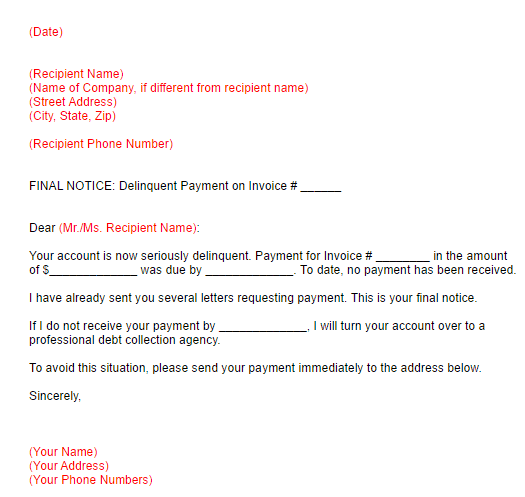
Official Collection Letter

Collection Letter On Company Letterhead

Collection Letter Template
Use this simple collection letter template when you need a professional starting point:
[Date]
[Recipient Name]
[Company Name]
[Address]
Subject: Outstanding Payment – [Invoice/Account Number]
Dear [Recipient Name]:
This letter is regarding the outstanding balance of [Amount] associated with [Invoice/Account Number]. According to our records, the payment was due on [Due Date] and has not yet been received.
Please arrange payment by [Payment Deadline] using [Payment Method]. If you have already submitted payment, please disregard this notice and contact us so that we can update our records.
If you have questions about the account or believe there is an error, please contact [Contact Name] at [Phone Number] or [Email Address].
Thank you for your prompt attention to this matter.
Sincerely,
[Full Name]
[Job Title]
[Company Name]
[Address]
[Phone Number]
[Email Address]
How to Write and Customize Collection Letters
Choose the sample that most closely matches the commercial request or transaction. Treat it as a framework rather than finished correspondence. Rewrite the opening so the recipient immediately understands why you are writing, then replace every placeholder with verified information.
Information to prepare
Collect product or service details, quantities, prices, payment terms, and response date. Including concrete information makes collection letters easier to understand and reduces unnecessary follow-up. Do not include confidential or unrelated details simply because they appear in a sample.
Tone and final review
Use a clear businesslike tone. Organize the information in chronological or logical order, state the action you expect, and provide a reasonable response method or deadline. Before sending, confirm spelling, contact details, dates, attachments, and the recipient’s correct title. The final version should support a timely business decision without sounding copied or unnecessarily complicated.
Related Letter Resources
Collection Letter Template
Use this simple collection letter template when you need a professional starting point:
[Date]
[Recipient Name]
[Company Name]
[Address]
Subject: Outstanding Payment – [Invoice/Account Number]
Dear [Recipient Name]:
This letter is regarding the outstanding balance of [Amount] associated with [Invoice/Account Number]. According to our records, the payment was due on [Due Date] and has not yet been received.
Please arrange payment by [Payment Deadline] using [Payment Method]. If you have already submitted payment, please disregard this notice and contact us so that we can update our records.
If you have questions about the account or believe there is an error, please contact [Contact Name] at [Phone Number] or [Email Address].
Thank you for your prompt attention to this matter.
Sincerely,
[Full Name]
[Job Title]
[Company Name]
[Address]
[Phone Number]
[Email Address]
How to Customize Collection Letters Before Use
Use the examples on this page as a starting point, then adapt the wording to the exact reader and purpose. Replace every placeholder with accurate names, dates, reference numbers, contact details, deadlines, and supporting facts. Keep the message focused on one main outcome so the recipient can understand and respond without guessing.
Before sending your collection letters, check that the tone suits the relationship, the subject line is specific, and the requested action is easy to identify. Remove irrelevant sample text, verify attachments, and proofread the final version for grammar, consistency, and factual accuracy. A concise, personalized letter is usually more credible than a generic copy.
20 Additional Collection Letters for Different Payment Situations
These additional collection examples cover staged invoice follow-up, business accounts, rent, tuition, memberships, services and reconciled balances while keeping the tone factual and professional.
- 1. First Friendly Invoice Follow-Up
- 2. Second Overdue Invoice Reminder
- 3. Final Internal Collection Notice
- 4. Partial Payment Follow-Up
- 5. Payment Plan Confirmation Letter
- 6. Returned Payment Follow-Up
- 7. Disputed Invoice Collection Follow-Up
- 8. Overdue Rent Reminder
- 9. Overdue Tuition Account Letter
- 10. Membership Dues Collection Letter
- 11. Subscription Balance Follow-Up
- 12. Consulting Invoice Collection Letter
- 13. Freelance Invoice Follow-Up
- 14. Wholesale Account Collection Letter
- 15. Service Contract Payment Follow-Up
- 16. Equipment Rental Balance Letter
- 17. Event Vendor Payment Follow-Up
- 18. Property Maintenance Invoice Follow-Up
- 19. Business-to-Business Statement Reminder
- 20. Collection Letter After Account Reconciliation
1. First Friendly Invoice Follow-Up
[Date]
[Your Name]
[Your Address]
[Email Address] | [Phone Number]
[Customer / Accounts Payable]
[Organization]
[Address]
Subject: Friendly Follow-Up on Invoice [Number]
Dear [Customer / Accounts Payable],
Our records show invoice [number] for [amount] remains unpaid after its due date of [date].
This may simply be an oversight, so I am sending a courteous reminder with the invoice reference and payment instructions. If you believe the balance is incorrect or already paid, please provide the relevant payment or account reference so the records can be reconciled.
Please arrange payment by [date] or let us know promptly if there is a genuine discrepancy. This letter is intended to resolve the account accurately and professionally and does not add rights or remedies beyond those permitted by the applicable agreement and law.
Sincerely,
[Signature]
[Your Name]
2. Second Overdue Invoice Reminder
[Date]
[Your Name]
[Your Address]
[Email Address] | [Phone Number]
[Customer / Accounts Payable]
[Organization]
[Address]
Subject: Second Reminder: Invoice [Number]
Dear [Customer / Accounts Payable],
Our records show invoice [number] remains outstanding despite our earlier reminder dated [date].
The current outstanding amount is [amount], and no payment or account query is recorded as of [date]. If you believe the balance is incorrect or already paid, please provide the relevant payment or account reference so the records can be reconciled.
Please provide payment or a clear status update by [date]. This letter is intended to resolve the account accurately and professionally and does not add rights or remedies beyond those permitted by the applicable agreement and law.
Sincerely,
[Signature]
[Your Name]
3. Final Internal Collection Notice
[Date]
[Your Name]
[Your Address]
[Email Address] | [Phone Number]
[Customer / Accounts Payable]
[Organization]
[Address]
Subject: Final Account Follow-Up Before Escalation
Dear [Customer / Accounts Payable],
Our records show the balance of [amount] on account [reference] is still overdue.
We have previously contacted you on [dates] and want to provide one final opportunity to resolve or dispute the balance through the normal account process. If you believe the balance is incorrect or already paid, please provide the relevant payment or account reference so the records can be reconciled.
Please contact us by [date] to pay, propose an acceptable arrangement, or identify the specific disputed item. This letter is intended to resolve the account accurately and professionally and does not add rights or remedies beyond those permitted by the applicable agreement and law.
Sincerely,
[Signature]
[Your Name]
4. Partial Payment Follow-Up
[Date]
[Your Name]
[Your Address]
[Email Address] | [Phone Number]
[Customer / Accounts Payable]
[Organization]
[Address]
Subject: Remaining Balance After Partial Payment
Dear [Customer / Accounts Payable],
Our records show a remaining balance of [amount] after receipt of partial payment [amount] on [date].
The payment has been credited to invoice/account [reference], leaving the stated balance outstanding. If you believe the balance is incorrect or already paid, please provide the relevant payment or account reference so the records can be reconciled.
Please arrange the remaining payment or confirm the agreed schedule for completing it. This letter is intended to resolve the account accurately and professionally and does not add rights or remedies beyond those permitted by the applicable agreement and law.
Sincerely,
[Signature]
[Your Name]
5. Payment Plan Confirmation Letter
[Date]
[Your Name]
[Your Address]
[Email Address] | [Phone Number]
[Customer / Debtor]
[Organization]
[Address]
Subject: Confirmation of Agreed Payment Plan
Dear [Customer / Debtor],
Our records show the agreed payment plan for account [reference].
The arrangement calls for payments of [amount] on [dates/frequency], subject to the written agreement and any applicable account terms. If you believe the balance is incorrect or already paid, please provide the relevant payment or account reference so the records can be reconciled.
Please make each payment on schedule and contact us before a due date if a documented problem arises. This letter is intended to resolve the account accurately and professionally and does not add rights or remedies beyond those permitted by the applicable agreement and law.
Sincerely,
[Signature]
[Your Name]
6. Returned Payment Follow-Up
[Date]
[Your Name]
[Your Address]
[Email Address] | [Phone Number]
[Customer / Account Holder]
[Organization]
[Address]
Subject: Returned Payment on Account [Reference]
Dear [Customer / Account Holder],
Our records show payment [reference/amount] submitted on [date] was returned or could not be processed.
The returned payment has not been treated as a new fee or penalty in this sample; the purpose is to notify you and request a valid replacement method. If you believe the balance is incorrect or already paid, please provide the relevant payment or account reference so the records can be reconciled.
Please arrange a replacement payment using an accepted method and reference the account number. This letter is intended to resolve the account accurately and professionally and does not add rights or remedies beyond those permitted by the applicable agreement and law.
Sincerely,
[Signature]
[Your Name]
7. Disputed Invoice Collection Follow-Up
[Date]
[Your Name]
[Your Address]
[Email Address] | [Phone Number]
[Customer / Accounts Payable]
[Organization]
[Address]
Subject: Follow-Up on Disputed Invoice [Number]
Dear [Customer / Accounts Payable],
Our records show invoice [number] is overdue and has been identified by you as disputed.
We would like to separate the disputed item [description/amount] from any undisputed amount and review the supporting records fairly. If you believe the balance is incorrect or already paid, please provide the relevant payment or account reference so the records can be reconciled.
Please send the specific basis and documents for the dispute so the account can be reconciled. This letter is intended to resolve the account accurately and professionally and does not add rights or remedies beyond those permitted by the applicable agreement and law.
Sincerely,
[Signature]
[Your Name]
8. Overdue Rent Reminder
[Date]
[Your Name]
[Your Address]
[Email Address] | [Phone Number]
[Tenant]
[Organization]
[Address]
Subject: Reminder Regarding Outstanding Rent
Dear [Tenant],
Our records show rent of [amount] for [period] appears outstanding under the tenancy record.
The payment was due on [date]. This sample should be adapted to the lease and local tenancy rules before use. If you believe the balance is incorrect or already paid, please provide the relevant payment or account reference so the records can be reconciled.
Please pay the verified amount or contact the property manager promptly if the ledger is incorrect. This letter is intended to resolve the account accurately and professionally and does not add rights or remedies beyond those permitted by the applicable agreement and law.
Sincerely,
[Signature]
[Your Name]
9. Overdue Tuition Account Letter
[Date]
[Your Name]
[Your Address]
[Email Address] | [Phone Number]
[Student / Responsible Payer]
[Organization]
[Address]
Subject: Outstanding Tuition Account Balance
Dear [Student / Responsible Payer],
Our records show a tuition or school account balance of [amount] remains unpaid for [term/period].
The account statement shows a due date of [date] and the charges should be checked against enrollment, aid, scholarships, and recorded payments. If you believe the balance is incorrect or already paid, please provide the relevant payment or account reference so the records can be reconciled.
Please settle the verified balance or contact the accounts office to resolve any discrepancy. This letter is intended to resolve the account accurately and professionally and does not add rights or remedies beyond those permitted by the applicable agreement and law.
Sincerely,
[Signature]
[Your Name]
10. Membership Dues Collection Letter
[Date]
[Your Name]
[Your Address]
[Email Address] | [Phone Number]
[Member]
[Organization]
[Address]
Subject: Reminder of Outstanding Membership Dues
Dear [Member],
Our records show membership dues of [amount] for [period] remain outstanding.
The dues were due on [date], and the membership record currently shows no matching payment. If you believe the balance is incorrect or already paid, please provide the relevant payment or account reference so the records can be reconciled.
Please renew or settle the dues if you wish to maintain membership under the applicable rules. This letter is intended to resolve the account accurately and professionally and does not add rights or remedies beyond those permitted by the applicable agreement and law.
Sincerely,
[Signature]
[Your Name]
11. Subscription Balance Follow-Up
[Date]
[Your Name]
[Your Address]
[Email Address] | [Phone Number]
[Subscriber / Customer]
[Organization]
[Address]
Subject: Outstanding Subscription Balance
Dear [Subscriber / Customer],
Our records show an unpaid subscription charge of [amount] for [period/service].
The balance relates to subscription [reference] and should be compared with any cancellation, downgrade, or payment record you may have. If you believe the balance is incorrect or already paid, please provide the relevant payment or account reference so the records can be reconciled.
Please pay the verified balance or send the relevant account information if you believe it should be adjusted. This letter is intended to resolve the account accurately and professionally and does not add rights or remedies beyond those permitted by the applicable agreement and law.
Sincerely,
[Signature]
[Your Name]
12. Consulting Invoice Collection Letter
[Date]
[Your Name]
[Your Address]
[Email Address] | [Phone Number]
[Client / Accounts Payable]
[Organization]
[Address]
Subject: Follow-Up on Consulting Invoice [Number]
Dear [Client / Accounts Payable],
Our records show consulting invoice [number] for completed services remains outstanding.
The invoice covers [project/period] and was due on [date] under the agreed payment terms. If you believe the balance is incorrect or already paid, please provide the relevant payment or account reference so the records can be reconciled.
Please arrange payment or advise the expected payment date and any unresolved invoice issue. This letter is intended to resolve the account accurately and professionally and does not add rights or remedies beyond those permitted by the applicable agreement and law.
Sincerely,
[Signature]
[Your Name]
13. Freelance Invoice Follow-Up
[Date]
[Your Name]
[Your Address]
[Email Address] | [Phone Number]
[Client]
[Organization]
[Address]
Subject: Payment Follow-Up for Freelance Invoice [Number]
Dear [Client],
Our records show payment for freelance work delivered on [date] under invoice [number] is overdue.
The deliverables were submitted as agreed, and the invoice due date was [date]. If you believe the balance is incorrect or already paid, please provide the relevant payment or account reference so the records can be reconciled.
Please confirm the payment date or identify any specific deliverable or invoice concern requiring review. This letter is intended to resolve the account accurately and professionally and does not add rights or remedies beyond those permitted by the applicable agreement and law.
Sincerely,
[Signature]
[Your Name]
14. Wholesale Account Collection Letter
[Date]
[Your Name]
[Your Address]
[Email Address] | [Phone Number]
[Business Customer / Accounts Payable]
[Organization]
[Address]
Subject: Outstanding Wholesale Account Balance
Dear [Business Customer / Accounts Payable],
Our records show the wholesale account balance of [amount] includes invoices now past due.
An attached or referenced statement lists the invoice numbers, dates, amounts, and payments currently recorded. If you believe the balance is incorrect or already paid, please provide the relevant payment or account reference so the records can be reconciled.
Please reconcile the statement and arrange payment of the undisputed balance. This letter is intended to resolve the account accurately and professionally and does not add rights or remedies beyond those permitted by the applicable agreement and law.
Sincerely,
[Signature]
[Your Name]
15. Service Contract Payment Follow-Up
[Date]
[Your Name]
[Your Address]
[Email Address] | [Phone Number]
[Client / Contract Administrator]
[Organization]
[Address]
Subject: Payment Follow-Up Under Service Agreement
Dear [Client / Contract Administrator],
Our records show a payment due under service agreement [reference] remains outstanding.
The amount of [amount] corresponds to the service period or milestone [description] and was due on [date]. If you believe the balance is incorrect or already paid, please provide the relevant payment or account reference so the records can be reconciled.
Please confirm payment status or advise which contractual item is preventing processing. This letter is intended to resolve the account accurately and professionally and does not add rights or remedies beyond those permitted by the applicable agreement and law.
Sincerely,
[Signature]
[Your Name]
16. Equipment Rental Balance Letter
[Date]
[Your Name]
[Your Address]
[Email Address] | [Phone Number]
[Renter / Customer]
[Organization]
[Address]
Subject: Outstanding Equipment Rental Balance
Dear [Renter / Customer],
Our records show a rental account balance of [amount] for equipment [reference] is overdue.
The account reflects rental dates [dates], recorded returns, and any verified charges stated in the rental agreement. If you believe the balance is incorrect or already paid, please provide the relevant payment or account reference so the records can be reconciled.
Please review the statement and pay the verified balance or identify the disputed item. This letter is intended to resolve the account accurately and professionally and does not add rights or remedies beyond those permitted by the applicable agreement and law.
Sincerely,
[Signature]
[Your Name]
17. Event Vendor Payment Follow-Up
[Date]
[Your Name]
[Your Address]
[Email Address] | [Phone Number]
[Event Client / Accounts Payable]
[Organization]
[Address]
Subject: Outstanding Event Services Invoice
Dear [Event Client / Accounts Payable],
Our records show invoice [number] for event services provided on [date] remains unpaid.
The invoice covers [services] as documented in the booking or service agreement. If you believe the balance is incorrect or already paid, please provide the relevant payment or account reference so the records can be reconciled.
Please arrange payment by [date] or provide any specific invoice issue for prompt review. This letter is intended to resolve the account accurately and professionally and does not add rights or remedies beyond those permitted by the applicable agreement and law.
Sincerely,
[Signature]
[Your Name]
18. Property Maintenance Invoice Follow-Up
[Date]
[Your Name]
[Your Address]
[Email Address] | [Phone Number]
[Property Owner / Manager]
[Organization]
[Address]
Subject: Payment Follow-Up for Maintenance Invoice
Dear [Property Owner / Manager],
Our records show maintenance invoice [number] for work completed at [property] remains outstanding.
The invoice references work order [number], completion date [date], and the agreed or approved scope. If you believe the balance is incorrect or already paid, please provide the relevant payment or account reference so the records can be reconciled.
Please confirm approval and payment status or advise what supporting record is missing. This letter is intended to resolve the account accurately and professionally and does not add rights or remedies beyond those permitted by the applicable agreement and law.
Sincerely,
[Signature]
[Your Name]
19. Business-to-Business Statement Reminder
[Date]
[Your Name]
[Your Address]
[Email Address] | [Phone Number]
[Accounts Payable Department]
[Organization]
[Address]
Subject: Account Statement Follow-Up
Dear [Accounts Payable Department],
Our records show the attached account statement shows overdue items totaling [amount].
The statement includes multiple invoices and credits so the balance can be reconciled against your records. If you believe the balance is incorrect or already paid, please provide the relevant payment or account reference so the records can be reconciled.
Please confirm the payment schedule or return a marked statement identifying any disputed entries. This letter is intended to resolve the account accurately and professionally and does not add rights or remedies beyond those permitted by the applicable agreement and law.
Sincerely,
[Signature]
[Your Name]
20. Collection Letter After Account Reconciliation
[Date]
[Your Name]
[Your Address]
[Email Address] | [Phone Number]
[Customer / Accounts Payable]
[Organization]
[Address]
Subject: Confirmed Balance After Account Reconciliation
Dear [Customer / Accounts Payable],
Our records show a balance of [amount] remains after both parties reviewed the account on [date].
The reconciliation addressed [credits/payments/disputes], leaving the stated amount as the remaining balance according to the agreed record. If you believe the balance is incorrect or already paid, please provide the relevant payment or account reference so the records can be reconciled.
Please arrange payment according to the confirmed terms or contact us if new documented information has emerged. This letter is intended to resolve the account accurately and professionally and does not add rights or remedies beyond those permitted by the applicable agreement and law.
Sincerely,
[Signature]
[Your Name]
Frequently Asked Questions About Collection Letters
What is a collection letter?
A collection letter is a written notice requesting payment of an unpaid or overdue balance. Businesses commonly use collection letters to recover outstanding invoices and customer accounts.
What should a collection letter say?
A collection letter should clearly identify the account, amount due, original due date, reason for the balance, requested payment date, payment instructions, and contact information for questions or disputes.
How do I write a collection letter for an unpaid invoice?
Start by identifying the invoice and customer, state the outstanding balance and due date, request payment by a specific date, provide payment instructions, and offer contact information for resolving questions about the invoice.
Should a collection letter be polite?
Yes. A professional and respectful tone is usually preferable, especially when dealing with customers or business partners. The letter can be firm about the payment requirement without using unnecessarily aggressive language.
Should I mention legal action in a collection letter?
Only when appropriate and accurate. Do not make false or exaggerated threats. Any reference to legal action or other collection remedies should reflect the actual rights and procedures available under the applicable agreement and law.
Can I send a collection letter by email?
Depending on the circumstances, a collection notice may be sent electronically or by physical mail. Keep appropriate records of what was sent and when it was sent, and follow any applicable legal or contractual requirements.
What is a final collection letter?
A final collection letter is a formal notice sent after previous payment reminders have not resolved an overdue account. It generally gives the recipient one more opportunity to resolve the balance before the sender takes the next permitted step.
What is a friendly collection letter?
A friendly collection letter is a polite payment reminder designed to encourage payment without unnecessarily damaging the customer relationship. It is often useful as an initial overdue-payment notice.
Can I customize a collection letter template?
Yes. Replace the sample information with accurate customer details, invoice numbers, dates, amounts, payment terms, and contact information. Make sure the final letter reflects your actual agreement and collection procedure.
Is a collection letter legally binding?
A collection letter itself does not automatically create a new legal obligation. Its legal significance depends on the underlying agreement, applicable law, the content of the letter, and the circumstances in which it is sent. For significant or disputed debts, consider obtaining appropriate legal advice.
Frequently Asked Questions About Collection Letters
What is a collection letter?
A collection letter is a written notice requesting payment of an unpaid or overdue balance. Businesses commonly use collection letters to recover outstanding invoices and customer accounts.
What should a collection letter say?
A collection letter should clearly identify the account, amount due, original due date, reason for the balance, requested payment date, payment instructions, and contact information for questions or disputes.
How do I write a collection letter for an unpaid invoice?
Start by identifying the invoice and customer, state the outstanding balance and due date, request payment by a specific date, provide payment instructions, and offer contact information for resolving questions about the invoice.
Should a collection letter be polite?
Yes. A professional and respectful tone is usually preferable, especially when dealing with customers or business partners. The letter can be firm about the payment requirement without using unnecessarily aggressive language.
Should I mention legal action in a collection letter?
Only when appropriate and accurate. Do not make false or exaggerated threats. Any reference to legal action or other collection remedies should reflect the actual rights and procedures available under the applicable agreement and law.
Can I send a collection letter by email?
Depending on the circumstances, a collection notice may be sent electronically or by physical mail. Keep appropriate records of what was sent and when it was sent, and follow any applicable legal or contractual requirements.
What is a final collection letter?
A final collection letter is a formal notice sent after previous payment reminders have not resolved an overdue account. It generally gives the recipient one more opportunity to resolve the balance before the sender takes the next permitted step.
What is a friendly collection letter?
A friendly collection letter is a polite payment reminder designed to encourage payment without unnecessarily damaging the customer relationship. It is often useful as an initial overdue-payment notice.
Can I customize a collection letter template?
Yes. Replace the sample information with accurate customer details, invoice numbers, dates, amounts, payment terms, and contact information. Make sure the final letter reflects your actual agreement and collection procedure.
Is a collection letter legally binding?
A collection letter itself does not automatically create a new legal obligation. Its legal significance depends on the underlying agreement, applicable law, the content of the letter, and the circumstances in which it is sent. For significant or disputed debts, consider obtaining appropriate legal advice.