Searching for useful persuasion letters samples that can be personalized quickly? This collection includes 11 or more practical examples created to make a clear, persuasive request and show why a timely response is reasonable. Rather than offering empty filler, the templates help you introduce the subject directly, establish the necessary context, and make the purpose clear to readers from the opening lines.
These examples can be adapted by employees, managers, customers, organizations, schools, donors, and public offices. A complete letter may need the exact request, supporting facts, benefits or impact, dates, evidence, deadline, and preferred response. Select the version closest to your circumstances, then replace every placeholder and broad claim with accurate names, dates, facts, and expectations. Specific information improves clarity, credibility, and relevance while reducing the risk of delay or misunderstanding.
Start by identifying the result you want and gathering the details that support it. Compare the preview images below, choose the most suitable downloadable template, and revise its wording for your audience and level of formality. Remove anything that does not apply, check grammar and factual accuracy, confirm attachments and contact information, and retain a copy of the final letter for future reference.
What Is a Persuasion Letter?
A persuasion letter is a formal or informal letter written to influence someone’s opinion or encourage a particular action.
The writer may be trying to persuade a:
- Customer
- Employer
- Business owner
- Manager
- Government official
- School administrator
- Teacher
- Community leader
- Donor
- Organization
- Colleague
- Client
- Voter
- Friend or family member
The subject can range from a business proposal or fundraising request to a school issue, community improvement, product purchase, donation, policy change, or personal request.
The strongest persuasive letters combine clear reasoning, relevant evidence, emotional appeal, credibility, and a specific call to action.
Purpose of a Persuasive Letter
The primary purpose of a persuasive letter is to influence the recipient’s decision.
A persuasive letter may be written to:
- Request approval
- Encourage someone to make a purchase
- Obtain financial support
- Request a donation
- Promote a product or service
- Gain support for a proposal
- Encourage a policy change
- Persuade an employer
- Request a meeting
- Support a candidate or cause
- Encourage community action
- Ask a school to make a change
- Convince a customer to take action
- Request sponsorship
- Promote an event
- Resolve a disagreement
- Change an existing decision
How to Write a Persuasive Letter
Writing a convincing letter requires more than using strong language. Your argument should be logical, relevant, respectful, and supported by information the reader can understand.
1. Know Your Audience
Before writing, consider who will read the letter and what matters to them.
A business executive may be interested in cost savings and return on investment, while a school administrator may be more concerned with student safety, educational benefits, or available resources.
Understanding your audience allows you to present your argument in a way that is meaningful to the recipient.
2. Clearly State Your Purpose
Tell the reader why you are writing as early as possible.
Instead of beginning with several paragraphs of background information, clearly explain the request or position.
For example:
I am writing to request your support for the proposed community recycling program.
This immediately establishes the purpose of the letter.
3. Explain the Problem or Situation
Give the reader enough background to understand why the issue matters.
Describe the current situation, the problem that needs to be addressed, or the opportunity being presented.
Keep the explanation focused on information that supports your argument.
4. Present Strong Reasons
Explain why the reader should agree with your request.
Use relevant reasons such as:
- Financial benefits
- Improved efficiency
- Safety
- Convenience
- Customer satisfaction
- Educational benefits
- Community benefits
- Environmental advantages
- Business growth
- Cost reduction
- Improved productivity
Choose reasons that are directly relevant to your audience.
5. Provide Evidence
A persuasive argument becomes stronger when supported by credible evidence.
Depending on the situation, evidence may include:
- Statistics
- Research
- Customer feedback
- Examples
- Financial information
- Professional experience
- Testimonials
- Comparisons
- Previous results
- Specific achievements
Avoid making unsupported claims that could reduce your credibility.
6. Address Possible Objections
If you know the reader may have concerns, address them before they become a reason to reject your proposal.
For example, if cost is likely to be an objection, explain how the proposed solution could reduce expenses over time or how the cost can be managed.
7. Make a Specific Request
End with a clear call to action.
Tell the reader exactly what you want them to do.
You might ask the recipient to:
- Approve a proposal
- Schedule a meeting
- Make a donation
- Sign a document
- Review an application
- Purchase a product
- Support an initiative
- Contact you
- Attend an event
- Change a decision
A specific request is more effective than simply saying that you hope the reader will consider your ideas.
Persuasive Letter Format
A standard persuasive letter format generally includes the following elements:
Date
Recipient Name
Job Title
Organization
Address
Subject: [Purpose of the Persuasive Letter]
Dear [Recipient Name]:
I am writing to [state your purpose clearly].
[Briefly explain the situation or problem.]
[Present your main reasons and supporting evidence.]
[Explain the benefits of accepting your proposal or taking the requested action.]
[Address any important concerns or objections.]
For these reasons, I respectfully request that you [specific action].
Thank you for taking the time to consider this request. I would be pleased to discuss the matter further and provide any additional information you may require.
Sincerely,
[Full Name]
[Title, if applicable]
[Organization, if applicable]
[Contact Information]
Types of Persuasion Letters
Business Persuasion Letter
A business persuasion letter is written to convince a business, customer, manager, partner, or other professional audience to take a particular action.
It may be used to promote a product, obtain a contract, secure approval, request a business meeting, propose a partnership, or introduce a new idea.
Keep business persuasion letters focused on measurable benefits such as revenue, efficiency, customer satisfaction, cost savings, or business growth.
Persuasive Sales Letter
A persuasive sales letter is designed to encourage a customer or potential customer to purchase a product or service.
An effective sales letter should explain:
- What is being offered
- Who the product or service is for
- What problem it solves
- Its main benefits
- Why the offer is valuable
- What makes it different
- How the customer can purchase or respond
Avoid making exaggerated claims. Accurate and credible information is more likely to build customer trust.
Persuasive Letter to a Customer
A persuasive customer letter can encourage a customer to try a product, renew a service, accept an offer, provide feedback, or take another action.
Use customer-focused benefits rather than concentrating entirely on the company.
Persuasive Letter for a Donation
A persuasive donation letter asks an individual, company, foundation, or organization to contribute money or resources to a cause.
Explain the purpose of the fundraising campaign, who will benefit, how contributions will be used, and why the recipient’s support is important.
Persuasive Fundraising Letter
A fundraising persuasion letter should combine a clear explanation of the cause with a specific request for support.
Where appropriate, include:
- Fundraising goal
- Purpose of the campaign
- People or community benefiting
- Specific impact of donations
- Deadline
- Donation instructions
- Contact information
Persuasive Letter to an Employer
A persuasive letter to an employer may be used to request a promotion, salary review, flexible working arrangement, additional responsibility, training opportunity, or another workplace change.
Focus on your contribution, measurable achievements, professional experience, and the benefits of approving your request.
Persuasive Letter to a Government Official
A persuasive letter to a government official can be used to advocate for a community issue, policy change, public project, funding request, or other civic matter.
Clearly explain the issue, provide relevant evidence, describe the effect on the community, and state the action you would like the official to take.
Persuasive Letter to a School
A persuasive letter to a school administrator or education authority may request a change to a school policy, program, facility, schedule, activity, or student service.
Use factual information and focus on how the proposed change could benefit students and the school community.
Persuasive Community Letter
A community persuasion letter encourages residents or local organizations to support a community project or address a shared problem.
Possible subjects include neighborhood improvements, public safety, environmental programs, parks, transportation, fundraising, and local events.
Persuasive Letter Structure
A strong persuasive letter can be organized into five simple parts:
Introduction
State the purpose and identify the issue.
Problem or Opportunity
Explain why the matter deserves attention.
Arguments and Evidence
Present the strongest reasons and supporting information.
Benefits and Response to Concerns
Explain the advantages of your proposal and address reasonable objections.
Call to Action
Tell the reader exactly what you want them to do.
This structure makes a persuasive letter easier to follow and helps the recipient understand the argument without searching through unnecessary information.
Persuasive Writing Techniques for Letters
Several techniques can make a persuasive letter more effective.
Use Facts and Evidence
Specific information can make an argument more credible.
Focus on Benefits
Explain how the proposed action will benefit the recipient or the people affected by the decision.
Use a Respectful Tone
Persuasion does not require aggressive language. A respectful argument can be firm while still maintaining a professional relationship.
Create a Sense of Relevance
Explain why the issue matters now rather than simply describing it as a general concern.
Use a Strong Call to Action
Make it easy for the recipient to understand what should happen next.
Establish Credibility
If your experience, professional position, research, or relationship to the issue is relevant, briefly explain it.
Combine Logic With Appropriate Emotion
Facts and reasoning are important, but an appropriate human story or explanation of real-world impact can also make an argument more meaningful.
Tips for Writing an Effective Persuasion Letter
Use these practical tips when preparing a persuasive letter:
- Define your objective before writing.
- Identify the person who has the authority to make the decision.
- Research your audience.
- State your main point early.
- Use specific and relevant reasons.
- Support important claims with evidence.
- Explain benefits clearly.
- Address likely objections.
- Avoid unnecessary repetition.
- Use professional and respectful language.
- Keep paragraphs short and readable.
- Make your request specific.
- Include a clear call to action.
- Proofread grammar, spelling, names, dates, and figures.
- Avoid exaggerated claims or misleading information.
- Include contact information when a response is required.
Persuasion Letter vs. Request Letter
A request letter primarily asks the recipient for something.
A persuasion letter goes further by explaining why the recipient should agree to the request.
For example, a request letter might simply ask a manager for additional training. A persuasive letter would explain how the training could improve employee productivity, reduce errors, and benefit the organization.
Many letters can serve both purposes because an effective request often requires some degree of persuasion.
Persuasion Letter vs. Recommendation Letter
A recommendation letter generally evaluates and supports a person for an opportunity such as employment, admission, or a scholarship.
A persuasion letter is broader and can be used to influence a decision about a person, proposal, product, policy, organization, project, or cause.
Persuasive Letter Template
Use this persuasive letter template as a starting point:
[Date]
[Recipient Name]
[Title]
[Organization]
[Address]
Subject: Request for Support for [Proposal/Issue]
Dear [Recipient Name]:
I am writing to ask you to [specific request].
[Briefly describe the issue, problem, or opportunity.]
I believe that [proposal or requested action] would be beneficial because [reason 1]. In addition, [reason 2]. [Add relevant evidence, examples, statistics, or other supporting information.]
I understand that [possible concern]. However, [explain why the concern can be addressed or why the benefits outweigh it].
For these reasons, I respectfully ask you to [specific action].
Thank you for considering this proposal. I would appreciate the opportunity to discuss it with you and provide any additional information that may be helpful.
Sincerely,
[Full Name]
[Title/Organization]
[Phone Number]
[Email Address]
See Sample Persuasion Letters Here
Persuasion Letter To Government
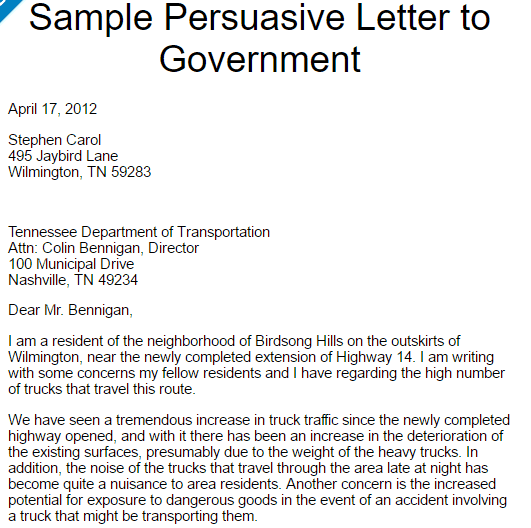

Persuasion Letter To Client


Persuasion Letter Samples Images Only:

Persuasion Letter Format With Instructions

Persuasion Letter Example

Persuasion Letter To Customers

Final Tips for a Successful Persuasive Letter
Before sending your letter, ask yourself three questions:
- Does the reader understand exactly what I want?
- Have I explained why the reader should agree?
- Have I made the next step clear and easy?
If the answer to all three questions is yes, your letter is more likely to communicate its purpose effectively.
Use these sample persuasion letters and persuasive letter templates as a starting point, then customize the wording, evidence, examples, and call to action for your specific situation.
How to Write and Customize Persuasion Letters
Choose the sample that most closely matches the proposal, recommendation, or requested action. Treat it as a framework rather than finished correspondence. Rewrite the opening so the recipient immediately understands why you are writing, then replace every placeholder with verified information.
Information to prepare
Collect supporting reasons, benefits, evidence, limits, and a specific call to action. Including concrete information makes persuasion letters easier to understand and reduces unnecessary follow-up. Do not include confidential or unrelated details simply because they appear in a sample.
Tone and final review
Use a respectful and convincing tone. Organize the information in chronological or logical order, state the action you expect, and provide a reasonable response method or deadline. Before sending, confirm spelling, contact details, dates, attachments, and the recipient’s correct title. The final version should make the requested outcome easy to evaluate without sounding copied or unnecessarily complicated.
Related Letter Resources
Final Tips for a Successful Persuasive Letter
Before sending your letter, ask yourself three questions:
- Does the reader understand exactly what I want?
- Have I explained why the reader should agree?
- Have I made the next step clear and easy?
If the answer to all three questions is yes, your letter is more likely to communicate its purpose effectively.
Use these sample persuasion letters and persuasive letter templates as a starting point, then customize the wording, evidence, examples, and call to action for your specific situation.
How to Customize Persuasion Letters Before Use
Use the examples on this page as a starting point, then adapt the wording to the exact reader and purpose. Replace every placeholder with accurate names, dates, reference numbers, contact details, deadlines, and supporting facts. Keep the message focused on one main outcome so the recipient can understand and respond without guessing.
Before sending your persuasion letters, check that the tone suits the relationship, the subject line is specific, and the requested action is easy to identify. Remove irrelevant sample text, verify attachments, and proofread the final version for grammar, consistency, and factual accuracy. A concise, personalized letter is usually more credible than a generic copy.
20 Additional Persuasion Letters for Different Situations
These examples add practical persuasive letters for workplace, community, education, business, transport, sustainability and service situations.
- 1. Persuasive Letter for Remote Work Trial
- 2. Persuasive Letter for Workplace Recycling
- 3. Persuasive Letter for School Library Funding
- 4. Persuasive Letter for Flexible Working Hours
- 5. Persuasive Letter for Employee Wellness Program
- 6. Persuasive Letter for Community Garden
- 7. Persuasive Letter for Safer Bicycle Facilities
- 8. Persuasive Letter for Energy Efficiency Upgrade
- 9. Persuasive Letter for Customer Plan Upgrade
- 10. Persuasive Letter for Vendor Partnership
- 11. Persuasive Sponsorship Letter
- 12. Persuasive Letter for Nonprofit Donation
- 13. Persuasive Letter for Volunteer Recruitment
- 14. Persuasive Letter for School Extracurricular Program
- 15. Persuasive Letter for Neighborhood Security Measures
- 16. Persuasive Letter for Better Public Transit Frequency
- 17. Persuasive Letter for Paperless Billing
- 18. Persuasive Letter for Safety Training
- 19. Persuasive Letter for Mentorship Program
- 20. Persuasive Letter for Healthier Cafeteria Options
1. Persuasive Letter for Remote Work Trial
[Date]
[Your Name / Title]
[Organization]
[Address]
[Email Address] | [Phone Number]
[Manager / HR Department]
[Organization / Department]
[Address]
Subject: Proposal for Remote Work Trial
Dear [Manager / HR Department],
I am writing to encourage consideration of a structured remote-work trial for eligible roles.
A limited trial would allow the organization to measure productivity, communication, service levels, and employee experience before making a permanent change. I believe this approach would be beneficial because it can test flexibility without committing to an unproven long-term arrangement.
I respectfully ask that you consider a time-limited pilot with clear performance measures. I would welcome the opportunity to discuss practical concerns, costs, and alternatives before a final decision is made.
Sincerely,
[Signature]
[Your Name]
2. Persuasive Letter for Workplace Recycling
[Date]
[Your Name / Title]
[Organization]
[Address]
[Email Address] | [Phone Number]
[Facilities / Management]
[Organization / Department]
[Address]
Subject: Proposal for Workplace Recycling Program
Dear [Facilities / Management],
I am writing to encourage consideration of a practical recycling program in the workplace.
Clearly labeled collection points and simple staff guidance can reduce mixed waste and improve disposal habits. I believe this approach would be beneficial because the program can lower avoidable waste while giving employees an easy way to participate.
I respectfully ask that you approve a small pilot in the busiest common areas. I would welcome the opportunity to discuss practical concerns, costs, and alternatives before a final decision is made.
Sincerely,
[Signature]
[Your Name]
3. Persuasive Letter for School Library Funding
[Date]
[Your Name / Title]
[Organization]
[Address]
[Email Address] | [Phone Number]
[School Board / Principal]
[Organization / Department]
[Address]
Subject: Proposal for Additional Library Funding
Dear [School Board / Principal],
I am writing to encourage consideration of additional funding for current library books and digital resources.
Students benefit when they can access age-appropriate, current, and varied reading and research materials. I believe this approach would be beneficial because updated resources can support literacy, coursework, independent study, and equitable access.
I respectfully ask that you prioritize a defined library allocation in the next budget review. I would welcome the opportunity to discuss practical concerns, costs, and alternatives before a final decision is made.
Sincerely,
[Signature]
[Your Name]
4. Persuasive Letter for Flexible Working Hours
[Date]
[Your Name / Title]
[Organization]
[Address]
[Email Address] | [Phone Number]
[Manager / HR Department]
[Organization / Department]
[Address]
Subject: Proposal for Flexible Working Hours
Dear [Manager / HR Department],
I am writing to encourage consideration of a flexible-hours option for roles where coverage can be maintained.
Staggered schedules can help employees manage commuting and personal responsibilities while preserving required service windows. I believe this approach would be beneficial because a well-designed arrangement may improve punctuality, retention, and coverage.
I respectfully ask that you consider a monitored pilot with minimum staffing rules. I would welcome the opportunity to discuss practical concerns, costs, and alternatives before a final decision is made.
Sincerely,
[Signature]
[Your Name]
5. Persuasive Letter for Employee Wellness Program
[Date]
[Your Name / Title]
[Organization]
[Address]
[Email Address] | [Phone Number]
[Management / HR Department]
[Organization / Department]
[Address]
Subject: Proposal for Employee Wellness Initiative
Dear [Management / HR Department],
I am writing to encourage consideration of a modest employee wellness initiative.
Low-cost activities such as health education, movement breaks, or access to support resources can encourage healthier routines. I believe this approach would be beneficial because better wellbeing can support attendance, engagement, and sustainable performance.
I respectfully ask that you review a small program with measurable participation and cost limits. I would welcome the opportunity to discuss practical concerns, costs, and alternatives before a final decision is made.
Sincerely,
[Signature]
[Your Name]
6. Persuasive Letter for Community Garden
[Date]
[Your Name / Title]
[Organization]
[Address]
[Email Address] | [Phone Number]
[Municipal / Community Committee]
[Organization / Department]
[Address]
Subject: Proposal for Community Garden
Dear [Municipal / Community Committee],
I am writing to encourage consideration of use of an appropriate local site for a community garden.
A managed garden can convert underused space into a shared area for food growing, education, and neighborhood participation. I believe this approach would be beneficial because the project can strengthen community involvement while improving the appearance and use of the site.
I respectfully ask that you consider a pilot plot subject to maintenance, access, and safety rules. I would welcome the opportunity to discuss practical concerns, costs, and alternatives before a final decision is made.
Sincerely,
[Signature]
[Your Name]
7. Persuasive Letter for Safer Bicycle Facilities
[Date]
[Your Name / Title]
[Organization]
[Address]
[Email Address] | [Phone Number]
[Transport / Municipal Authority]
[Organization / Department]
[Address]
Subject: Proposal for Safer Bicycle Facilities
Dear [Transport / Municipal Authority],
I am writing to encourage consideration of improved bicycle lanes or parking in [area].
Visible, continuous infrastructure can reduce conflicts between bicycles, vehicles, and pedestrians on routes with regular cycle use. I believe this approach would be beneficial because safer facilities may support short local trips and reduce pressure on road and parking capacity.
I respectfully ask that you include the route in the next traffic and active-transport assessment. I would welcome the opportunity to discuss practical concerns, costs, and alternatives before a final decision is made.
Sincerely,
[Signature]
[Your Name]
8. Persuasive Letter for Energy Efficiency Upgrade
[Date]
[Your Name / Title]
[Organization]
[Address]
[Email Address] | [Phone Number]
[Management / Property Owner]
[Organization / Department]
[Address]
Subject: Proposal for Energy Efficiency Improvements
Dear [Management / Property Owner],
I am writing to encourage consideration of targeted energy-efficiency upgrades at [building/site].
Measures such as LED lighting, controls, maintenance, and equipment scheduling can be evaluated using current consumption data. I believe this approach would be beneficial because the strongest measures can reduce operating costs without compromising service.
I respectfully ask that you authorize an energy review and prioritize upgrades with a reasonable payback. I would welcome the opportunity to discuss practical concerns, costs, and alternatives before a final decision is made.
Sincerely,
[Signature]
[Your Name]
9. Persuasive Letter for Customer Plan Upgrade
[Date]
[Your Name / Title]
[Organization]
[Address]
[Email Address] | [Phone Number]
[Customer / Client]
[Organization / Department]
[Address]
Subject: Recommendation to Upgrade Service Plan
Dear [Customer / Client],
I am writing to encourage consideration of moving from the current plan to [proposed plan].
The proposed plan includes [specific features/capacity/support] that match the customer’s documented usage or upcoming needs. I believe this approach would be beneficial because the change can reduce limitations or repeated add-on costs if the customer actually uses the added features.
I respectfully ask that you review the comparison and consider the upgrade if the added value justifies the cost. I would welcome the opportunity to discuss practical concerns, costs, and alternatives before a final decision is made.
Sincerely,
[Signature]
[Your Name]
10. Persuasive Letter for Vendor Partnership
[Date]
[Your Name / Title]
[Organization]
[Address]
[Email Address] | [Phone Number]
[Prospective Vendor / Business Partner]
[Organization / Department]
[Address]
Subject: Proposal for Business Partnership
Dear [Prospective Vendor / Business Partner],
I am writing to encourage consideration of a structured partnership between our organizations.
Our capabilities in [area] complement your strengths in [area], creating an opportunity to serve [market/customer need] more effectively. I believe this approach would be beneficial because a carefully scoped collaboration can create shared value while keeping responsibilities and risks clear.
I respectfully ask that you meet to review a limited initial project and commercial terms. I would welcome the opportunity to discuss practical concerns, costs, and alternatives before a final decision is made.
Sincerely,
[Signature]
[Your Name]
11. Persuasive Sponsorship Letter
[Date]
[Your Name / Title]
[Organization]
[Address]
[Email Address] | [Phone Number]
[Potential Sponsor]
[Organization / Department]
[Address]
Subject: Sponsorship Proposal for [Event/Program]
Dear [Potential Sponsor],
I am writing to encourage consideration of sponsorship of [event/program].
The program reaches [audience] and offers defined recognition or engagement opportunities that can be matched to the sponsor’s objectives. I believe this approach would be beneficial because the sponsorship can support a worthwhile activity while providing transparent, agreed visibility.
I respectfully ask that you consider one of the listed sponsorship levels or discuss a tailored package. I would welcome the opportunity to discuss practical concerns, costs, and alternatives before a final decision is made.
Sincerely,
[Signature]
[Your Name]
12. Persuasive Letter for Nonprofit Donation
[Date]
[Your Name / Title]
[Organization]
[Address]
[Email Address] | [Phone Number]
[Potential Donor]
[Organization / Department]
[Address]
Subject: Request to Support [Nonprofit Program]
Dear [Potential Donor],
I am writing to encourage consideration of a donation to support [specific nonprofit program].
The program addresses [documented need] through [specific activities], and funds are allocated to clearly described purposes. I believe this approach would be beneficial because a contribution can help deliver measurable services or resources to the intended beneficiaries.
I respectfully ask that you consider a donation at a level that is comfortable and appropriate. I would welcome the opportunity to discuss practical concerns, costs, and alternatives before a final decision is made.
Sincerely,
[Signature]
[Your Name]
13. Persuasive Letter for Volunteer Recruitment
[Date]
[Your Name / Title]
[Organization]
[Address]
[Email Address] | [Phone Number]
[Community Members / Employees / Students]
[Organization / Department]
[Address]
Subject: Invitation to Volunteer for [Program]
Dear [Community Members / Employees / Students],
I am writing to encourage consideration of volunteering for [program/event].
The project needs people to help with [specific tasks] during [dates/times], and training or guidance will be provided. I believe this approach would be beneficial because volunteers can contribute directly to a defined community or organizational goal.
I respectfully ask that you register for a suitable shift or role if you are able to participate. I would welcome the opportunity to discuss practical concerns, costs, and alternatives before a final decision is made.
Sincerely,
[Signature]
[Your Name]
14. Persuasive Letter for School Extracurricular Program
[Date]
[Your Name / Title]
[Organization]
[Address]
[Email Address] | [Phone Number]
[Principal / School Board]
[Organization / Department]
[Address]
Subject: Proposal for New Extracurricular Program
Dear [Principal / School Board],
I am writing to encourage consideration of a new [club/activity] for students.
Student interest has been shown through [survey/requests], and the program can be run with defined supervision, schedule, and resource needs. I believe this approach would be beneficial because the activity can build skills, engagement, and constructive participation beyond regular classes.
I respectfully ask that you approve a trial term with clear safeguarding and supervision arrangements. I would welcome the opportunity to discuss practical concerns, costs, and alternatives before a final decision is made.
Sincerely,
[Signature]
[Your Name]
15. Persuasive Letter for Neighborhood Security Measures
[Date]
[Your Name / Title]
[Organization]
[Address]
[Email Address] | [Phone Number]
[Residents Association / Property Management]
[Organization / Department]
[Address]
Subject: Proposal for Practical Security Improvements
Dear [Residents Association / Property Management],
I am writing to encourage consideration of targeted security improvements in [building/neighborhood].
Residents have identified specific issues such as poor lighting, uncontrolled access, or limited visibility that can be addressed without creating unnecessary intrusion. I believe this approach would be beneficial because practical improvements can reduce opportunities for incidents and improve confidence.
I respectfully ask that you review the listed measures and prioritize those supported by evidence and budget. I would welcome the opportunity to discuss practical concerns, costs, and alternatives before a final decision is made.
Sincerely,
[Signature]
[Your Name]
16. Persuasive Letter for Better Public Transit Frequency
[Date]
[Your Name / Title]
[Organization]
[Address]
[Email Address] | [Phone Number]
[Transit Authority]
[Organization / Department]
[Address]
Subject: Proposal for Increased Service Frequency
Dear [Transit Authority],
I am writing to encourage consideration of more frequent service on route [number/area] during [time period].
Current intervals create long waits and overcrowding at predictable times, based on [observations/data if available]. I believe this approach would be beneficial because better frequency can improve reliability and make the route more useful for regular commuters.
I respectfully ask that you review ridership and operating data for a targeted timetable adjustment. I would welcome the opportunity to discuss practical concerns, costs, and alternatives before a final decision is made.
Sincerely,
[Signature]
[Your Name]
17. Persuasive Letter for Paperless Billing
[Date]
[Your Name / Title]
[Organization]
[Address]
[Email Address] | [Phone Number]
[Management / Customers]
[Organization / Department]
[Address]
Subject: Proposal for Paperless Billing Option
Dear [Management / Customers],
I am writing to encourage consideration of expanding the use of paperless billing.
Electronic statements can be delivered quickly, archived easily, and offered alongside accessibility or paper exceptions for people who need them. I believe this approach would be beneficial because the option can reduce printing and mailing costs while improving convenience for many users.
I respectfully ask that you adopt paperless billing as an opt-in or well-supported default where appropriate. I would welcome the opportunity to discuss practical concerns, costs, and alternatives before a final decision is made.
Sincerely,
[Signature]
[Your Name]
18. Persuasive Letter for Safety Training
[Date]
[Your Name / Title]
[Organization]
[Address]
[Email Address] | [Phone Number]
[Management / Safety Committee]
[Organization / Department]
[Address]
Subject: Proposal for Refresher Safety Training
Dear [Management / Safety Committee],
I am writing to encourage consideration of refresher safety training for [team/site].
Recent changes in equipment, staffing, procedures, or identified knowledge gaps make a short focused refresher timely. I believe this approach would be beneficial because consistent training can reinforce safe practice and reduce avoidable errors.
I respectfully ask that you schedule a targeted session with attendance and competency records. I would welcome the opportunity to discuss practical concerns, costs, and alternatives before a final decision is made.
Sincerely,
[Signature]
[Your Name]
19. Persuasive Letter for Mentorship Program
[Date]
[Your Name / Title]
[Organization]
[Address]
[Email Address] | [Phone Number]
[Leadership / HR Department]
[Organization / Department]
[Address]
Subject: Proposal for Employee Mentorship Program
Dear [Leadership / HR Department],
I am writing to encourage consideration of a voluntary mentorship program for employees.
Pairing experienced employees with colleagues seeking development can create structured knowledge sharing without replacing formal management. I believe this approach would be beneficial because the program can support learning, internal mobility, and retention.
I respectfully ask that you approve a small pilot with matching criteria and feedback measures. I would welcome the opportunity to discuss practical concerns, costs, and alternatives before a final decision is made.
Sincerely,
[Signature]
[Your Name]
20. Persuasive Letter for Healthier Cafeteria Options
[Date]
[Your Name / Title]
[Organization]
[Address]
[Email Address] | [Phone Number]
[Facilities / Food Service Manager]
[Organization / Department]
[Address]
Subject: Proposal for Healthier Cafeteria Choices
Dear [Facilities / Food Service Manager],
I am writing to encourage consideration of adding more balanced food options to the cafeteria menu.
Employees or students have requested more choices such as [examples], and these can be offered alongside existing items rather than removing popular options. I believe this approach would be beneficial because greater choice can support different dietary needs and healthier everyday decisions.
I respectfully ask that you test a small set of additional options and review demand. I would welcome the opportunity to discuss practical concerns, costs, and alternatives before a final decision is made.
Sincerely,
[Signature]
[Your Name]
Frequently Asked Questions About Persuasion Letters
What is a persuasion letter?
A persuasion letter is a written message intended to influence a reader’s opinion, decision, or behavior. It uses reasons, evidence, benefits, and a clear request to encourage the desired response.
How do I start a persuasive letter?
Begin by clearly stating why you are writing and what you want the recipient to consider or do. A direct opening helps the reader understand the purpose immediately.
What makes a persuasive letter effective?
An effective persuasive letter has a clear purpose, strong reasoning, credible evidence, relevant benefits, a respectful tone, and a specific call to action.
How long should a persuasive letter be?
A persuasive letter should generally be long enough to present the argument properly but short enough to maintain the reader’s attention. For most business and professional situations, one page is a useful target.
Should a persuasive letter include evidence?
Yes. Facts, statistics, examples, research, testimonials, financial information, and other relevant evidence can make your argument more credible.
Can a persuasive letter be informal?
Yes. The tone should depend on the audience and purpose. A business or official persuasion letter should normally be professional, while a personal persuasive letter can be more conversational.
How do I end a persuasive letter?
End by clearly stating the action you want the recipient to take. Thank the reader for considering your argument and provide contact information if a response or discussion is expected.
Can I use a persuasive letter to request a donation?
Yes. Donation and fundraising letters frequently use persuasive writing to explain a cause, demonstrate its impact, and encourage the recipient to contribute.
Can I use a persuasive letter to request a change at work?
Yes. Explain the change you are requesting, provide evidence or examples supporting your proposal, and demonstrate how the change could benefit both you and the organization.
Can I customize a persuasion letter template?
Yes. Replace the sample information with details specific to your audience, issue, proposal, supporting evidence, and desired action. A customized letter is generally much more effective than a generic message.