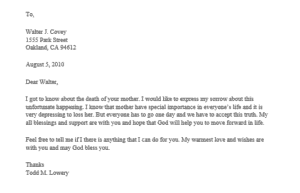
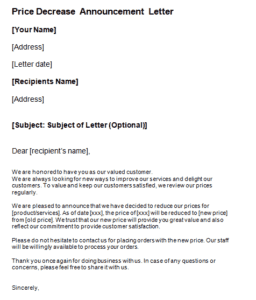
Searching for useful authorization letters to act on behalf samples that can be personalized quickly? This collection includes 8 or more practical examples created to record authority, instructions, consent, approval, or responsibilities without avoidable ambiguity. Rather than offering empty filler, the templates help you introduce the subject directly, establish the necessary context, and make the purpose clear to readers from the opening lines.
These examples can be adapted by individuals, employers, institutions, representatives, and public offices. A complete letter may need the parties, scope, effective dates, limits, responsibilities, references, and signatures. Select the version closest to your circumstances, then replace every placeholder and broad claim with accurate names, dates, facts, and expectations. Specific information improves clarity, credibility, and relevance while reducing the risk of delay or misunderstanding.
Start by identifying the result you want and gathering the details that support it. Compare the preview images below, choose the most suitable downloadable template, and revise its wording for your audience and level of formality. Remove anything that does not apply, check grammar and factual accuracy, confirm attachments and contact information, and retain a copy of the final letter for future reference.
On this page, you will find authorization letter samples, authority letter templates, authorization letter formats, and examples of letters authorizing someone to act on your behalf. These examples cover common situations such as passport applications, document collection, meeting representation, signing documents, and activating or deactivating services.
Use these samples as a starting point and customize them according to your specific situation and the requirements of the organization receiving the letter.
What Is an Authorization Letter to Act on Behalf?
An authorization letter to act on behalf is a written permission that allows another person to perform a specific action for you.
For example, you might authorize someone to:
- Collect documents on your behalf
- Pick up personal belongings
- Submit or collect an application
- Attend a meeting
- Represent you in a discussion
- Sign specific documents
- Activate or deactivate a service
- Handle an administrative task
- Communicate with a company or institution
- Collect a passport or other document
- Receive an item on your behalf
- Complete a specific transaction
The authority granted should be specific and limited to the task for which permission is being provided unless broader authority is genuinely required.
An authorization letter does not automatically give another person unlimited control over your affairs. The recipient organization may also have its own identification, verification, witnessing, notarization, or documentation requirements.
When Do You Need an Authorization Letter?
An authority letter to act on behalf is useful when you cannot personally complete a particular task and need someone you trust to handle it for you.
Common situations include:
- Passport application or collection
- Document submission or collection
- Picking up personal belongings
- Collecting certificates
- Collecting educational documents
- Attending a meeting on your behalf
- Representing you in a business meeting
- Signing specified documents
- Handling utility or service requests
- Activating or deactivating services
- Receiving packages or property
- Handling administrative procedures
- Communicating with an organization
- Submitting forms
- Collecting official records
The exact requirements depend on the organization and the nature of the task. Some institutions may require a government-issued identification document, a copy of the authorizer’s ID, witnesses, notarization, or their own authorization form.
How to Write an Authorization Letter
A good authorization letter format should make it immediately clear who is giving permission, who is receiving it, what they are authorized to do, and how long the authorization remains valid.
1. Identify the Person Giving the Authorization
Start with your full name and relevant contact information.
If the letter is being issued by a company or organization, include the organization’s name, address, and the position of the person authorized to issue the letter.
2. Identify the Authorized Person
Clearly provide the full name of the person you are authorizing.
Where appropriate, include additional identification details such as an identification number or relationship to you, particularly when the recipient organization requires verification.
3. State the Purpose of the Authorization
Clearly explain what the representative is authorized to do.
For example:
I hereby authorize [Full Name] to collect my passport on my behalf.
or:
I authorize [Full Name] to represent me at the meeting scheduled for [Date].
Avoid vague statements such as “I authorize this person to handle my affairs” unless broad authority is actually intended and appropriate.
4. Specify the Scope of Authority
Describe exactly what the person may do.
If the representative can only collect a document, say so. If they can sign a specific form, identify the form or transaction.
Specific wording reduces the possibility of misunderstanding or unauthorized action.
5. Include the Effective Date
State when the authorization begins.
If the authority is temporary, provide an expiration date.
For example:
This authorization is valid from September 10, 2026, through September 20, 2026.
6. Add Any Restrictions
If the representative is authorized to perform only certain tasks, clearly state the limitations.
For example:
This authorization is limited to collecting the documents listed above and does not authorize the representative to make any other changes to my account.
7. Provide Verification Details
If necessary, include relevant reference numbers, application numbers, account details, document names, or transaction information.
Avoid including unnecessary sensitive information.
8. Sign the Letter
The person giving the authorization should sign and date the letter.
Depending on the organization or jurisdiction, additional signatures, witnesses, notarization, identification documents, or official forms may be required.
Authorization Letter Format
A standard authorization letter to act on behalf format can look like this:
[Your Full Name]
[Your Address]
[Phone Number]
[Email Address]
[Date]
To:
[Name of Organization / Department]
[Address]
Subject: Authorization to Act on My Behalf
Dear Sir/Madam:
I, [Your Full Name], hereby authorize [Authorized Person’s Full Name], holder of [identification details if required], to act on my behalf for the purpose of [clearly describe the specific task].
The authorized representative may [list the specific actions permitted].
This authorization is valid from [Start Date] until [End Date], unless revoked earlier in writing.
Please provide the authorized representative with the necessary assistance to complete the above-mentioned task. A copy of my identification and any other required supporting documents are attached, if applicable.
If you require confirmation or additional information, please contact me at [phone/email].
Thank you for your cooperation.
Sincerely,
[Your Full Name]
[Signature]
[Date]
This template can be adapted for a letter of authorization, authority letter, authorization to represent someone, authorization to collect documents, authorization to sign documents, or authorization to handle a specific service.
Types of Authorization Letters to Act on Behalf
Different situations require different forms of authorization. The following examples cover several common uses.
Authorization Letter to Act on Behalf
A general authorization letter to act on behalf gives another person permission to perform a clearly identified task for you.
This is useful when you cannot personally attend to a particular administrative, personal, or business matter.
The authorization should specify exactly what the representative is allowed to do rather than giving unnecessarily broad powers.
Authority Letter for Passport Application
A passport authorization letter can be used when an applicant needs to authorize another person to handle a particular passport-related task.
The example on this page concerns a situation where an applicant cannot attend personally and authorizes another person to handle the passport application-related matter.
Always check the passport authority’s current requirements because some passport services require the applicant’s personal presence and may not accept a private authorization letter for certain procedures.
Authorization Letter to Collect Documents
An authorization letter to collect documents gives another person permission to receive documents on your behalf.
It may be used for:
- Certificates
- Academic records
- Passports
- Official correspondence
- Application documents
- Personal records
- Other documents
Clearly identify the documents being collected and the authorized representative.
Authority Letter to Collect Personal Belongings
An authority letter to collect personal belongings allows another person to collect specified property on your behalf.
The existing example on this page concerns authorization for someone to pick up a notebook and other personal items.
Include enough identifying information for the organization to confirm what is being collected.
Authorization Letter for Meeting Representation
An authorization letter for meeting representation authorizes another person to attend a meeting and represent your interests.
This can be useful when you cannot attend a business, project, association, or organizational meeting yourself.
The letter should identify the meeting, date, authorized representative, and scope of the representative’s authority.
Authorization Letter to Represent Someone
An authorization letter to represent someone formally confirms that another person has permission to communicate or participate on behalf of the authorizing individual.
Explain exactly what the representative is permitted to discuss, submit, receive, or decide.
Authorization Letter to Sign Documents
An authorization letter to sign documents gives another person permission to sign specified documents on your behalf.
This type of authorization should be particularly specific. Identify the documents or transaction involved and explain any limitations.
Some documents may require a formal power of attorney, notarized authorization, corporate resolution, or another legally recognized form rather than an ordinary authorization letter.
Authorization Letter for Services
An authorization letter for services can allow another person to request, activate, deactivate, modify, or manage a specific service on your behalf.
The example on this page concerns authorizing another person to activate or deactivate services.
Specify the service involved and the exact action the representative is permitted to take.
Authorization Letter vs. Power of Attorney
An authorization letter and a power of attorney are not necessarily the same thing.
An authorization letter is often used for a specific, limited task, such as collecting a document or attending a particular meeting.
A power of attorney is a more formal legal instrument that may grant broader authority to act on another person’s behalf.
Whether an authorization letter is sufficient depends on the nature of the task, the organization involved, the jurisdiction, and applicable law.
For significant financial, property, legal, healthcare, or contractual matters, obtain appropriate professional advice rather than assuming that a simple authorization letter is sufficient.
What Should an Authorization Letter Include?
A professional letter of authorization should normally include:
- Full name of the person giving authorization
- Address and contact information
- Full name of the authorized representative
- Identification details when required
- Specific purpose of the authorization
- Exact duties or actions authorized
- Relevant application, account, or transaction reference
- Effective date
- Expiration date when applicable
- Restrictions or limitations
- Supporting documents if required
- Signature of the authorizing person
- Date of signature
Including these details makes the authorization easier for the receiving organization to verify.
Tips for Writing a Safe Authorization Letter
Authorization gives another person permission to act in your place, so it should be prepared carefully.
Authorize Only What Is Necessary
Do not give broader authority than the situation requires. If someone only needs to collect a document, authorize document collection rather than giving them general control over your affairs.
Choose Someone You Trust
Make sure the authorized representative is someone you trust to perform the specified task.
Include an Expiration Date
For temporary authorization, specify when the authority ends.
Identify the Exact Transaction
Where possible, include the document, application, account, order, meeting, or service involved.
Keep Copies
Keep a copy of the signed authorization letter and any supporting documents for your records.
Protect Sensitive Information
Only include personal or financial information that is actually required.
Check the Recipient’s Requirements
Banks, government agencies, passport offices, schools, hospitals, companies, and other organizations may have their own authorization forms or verification procedures.
A generic authorization letter may not always be accepted.
Common Mistakes in Authorization Letters
Avoid these mistakes when preparing an authority letter:
- Failing to identify the authorized person
- Giving vague or unlimited authority
- Omitting the purpose of the authorization
- Not stating the effective period
- Forgetting to sign and date the letter
- Using incorrect identification information
- Failing to attach required supporting documents
- Giving authority for actions that require a formal legal document
- Sending unnecessary sensitive information
- Assuming every organization accepts the same authorization format
The more clearly the authorization is defined, the easier it is for the recipient to verify and process.
Sample Authorization Letters
The examples on this page demonstrate several practical forms of authorization letters to act on behalf, including authorization for passport-related matters, collecting personal items, general authority, meeting participation, signing documents, and managing services.
Use these sample authorization letters as references when preparing your own letter. Replace the names, dates, purpose, identification information, and authorized actions with details that accurately reflect your situation.
Always check with the organization receiving the letter before relying on a generic template, particularly for government, banking, legal, property, healthcare, or other regulated matters.
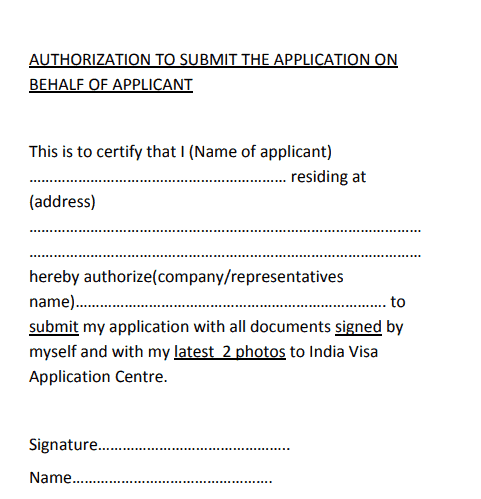
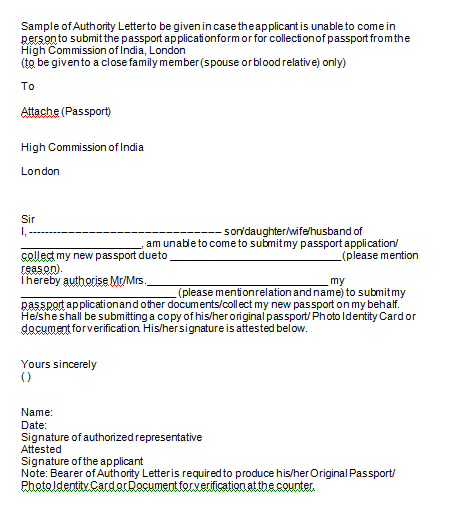
Following letter is for particular case in which the application is unable to come and he/she is giving authority some else for his work which is passport application form here.
———————————————–
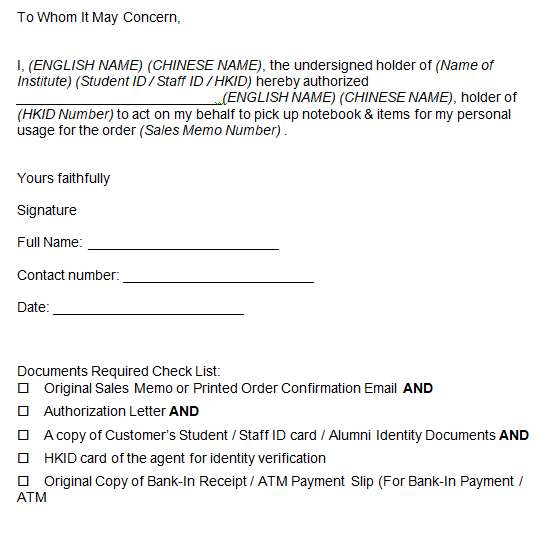
Following is one of the very important type of authorization letters to act on behalf of someone. This particular example is for the case when someone is picking up notebook and other personal items on behalf of someone.

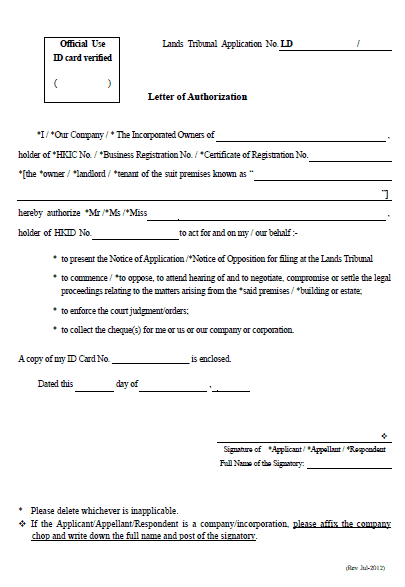
This is authorization form to give authority to someone else on your behalf. In many countries this is used as standard form for such type of authorization. Please use with precaution.
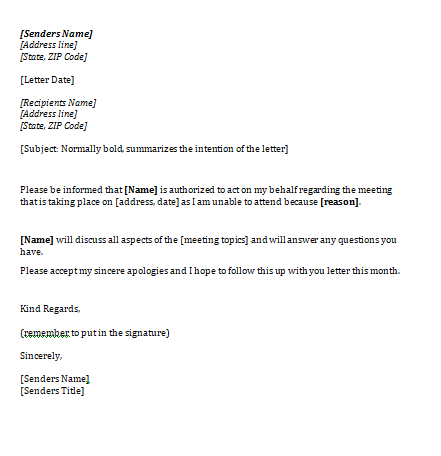
In following type of authorization letter on behalf one person is giving authority to other person to represent in a meeting and discuss various project level things with fellows. This is also very good example of authorization on someone else’s behalf.
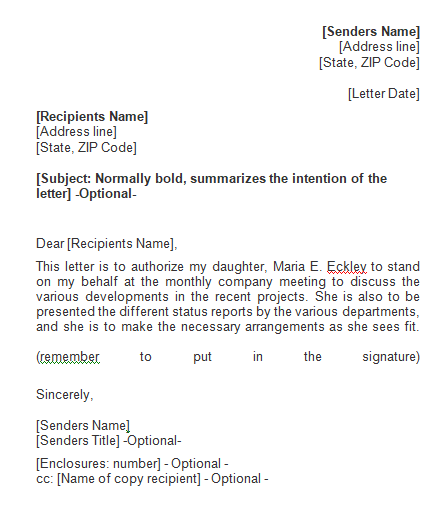

One more important type of authorization letter of a meeting participation.
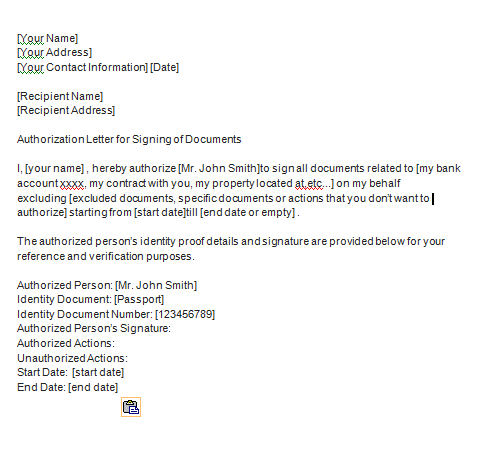
For authorizing signing of documents on someone’s behalf yet another beautiful and practical examples of authorization letters on behalf.

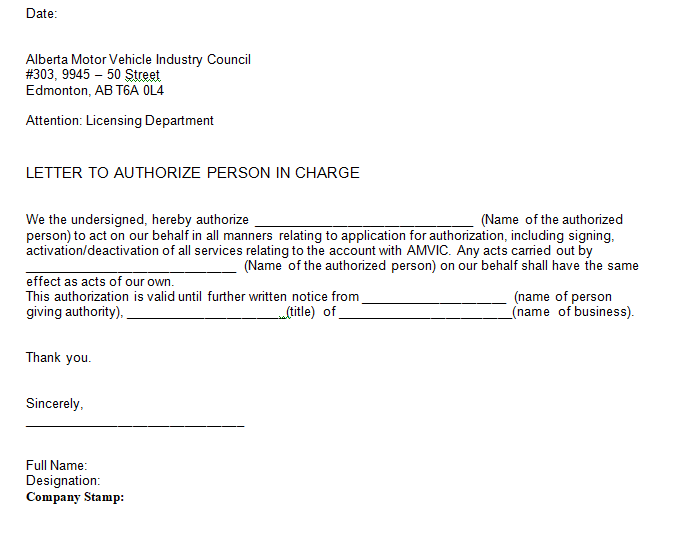
In this particular case someone is authorizing other person to activate or deactivate services on his behalf.
How to Write and Customize Authorization letters to Act on Behalf
Choose the sample that most closely matches the decision, permission, or official request. Treat it as a framework rather than finished correspondence. Rewrite the opening so the recipient immediately understands why you are writing, then replace every placeholder with verified information.
Information to prepare
Collect the responsible authority, reference number, scope, effective dates, and conditions. Including concrete information makes authorization letters to act on behalf easier to understand and reduces unnecessary follow-up. Do not include confidential or unrelated details simply because they appear in a sample.
Tone and final review
Use a formal and precise tone. Organize the information in chronological or logical order, state the action you expect, and provide a reasonable response method or deadline. Before sending, confirm spelling, contact details, dates, attachments, and the recipient’s correct title. The final version should create a clear official record without sounding copied or unnecessarily complicated.
Related Letter Resources
How to Customize Authorization letters to Act on Behalf Before Use
Use the examples on this page as a starting point, then adapt the wording to the exact reader and purpose. Replace every placeholder with accurate names, dates, reference numbers, contact details, deadlines, and supporting facts. Keep the message focused on one main outcome so the recipient can understand and respond without guessing.
Before sending your authorization letters to act on behalf, check that the tone suits the relationship, the subject line is specific, and the requested action is easy to identify. Remove irrelevant sample text, verify attachments, and proofread the final version for grammar, consistency, and factual accuracy. A concise, personalized letter is usually more credible than a generic copy.
20 Additional Authorization Letters to Act on Behalf
These additional examples cover specific, limited authorization for document collection, filings, account services, property tasks, travel, procurement and administrative procedures.
- 1. Authorization to Collect a Passport
- 2. Authorization to Collect Bank Documents
- 3. Authorization to Submit Tax Documents
- 4. Authorization for Vehicle Registration Processing
- 5. Authorization for Property Management Task
- 6. Authorization to Collect Medical Records
- 7. Authorization to Collect School Records
- 8. Authorization to Handle Utility Account Service
- 9. Authorization to File an Insurance Claim Document
- 10. Authorization to Collect a Parcel
- 11. Authorization to Collect Legal Documents
- 12. Authorization to Attend a Business Meeting
- 13. Authorization to Submit a Tender Package
- 14. Authorization for Procurement Pickup
- 15. Authorization for Customs Document Collection
- 16. Authorization to Collect Salary or Cheque
- 17. Authorization for Lease Document Handover
- 18. Authorization for Company Registration Document Filing
- 19. Authorization to Make Travel Bookings
- 20. Authorization to Submit University Admission Documents
1. Authorization to Collect a Passport
[Date]
[Your Name / Organization]
[Address]
[Email Address] | [Phone Number]
[Passport Office / Collection Center]
[Organization]
[Address]
Subject: Authorization to Collect Passport
Dear [Passport Office / Collection Center],
I, [your full name], authorize [authorized person’s full name and ID/reference] to act on my behalf for collecting my passport or travel document from [office/location].
The authority is limited to presenting required identification, receipt, or collection slip and receiving the document on my behalf. It is valid from [start date] through [end date] unless revoked earlier in writing. The authorized person may present this letter together with identification where required.
Please permit the authorized person to complete the collection and sign any routine acknowledgment of receipt. This authorization does not grant authority beyond the specific purpose stated above.
Sincerely,
[Signature]
[Your Name]
2. Authorization to Collect Bank Documents
[Date]
[Your Name / Organization]
[Address]
[Email Address] | [Phone Number]
[Bank / Branch Manager]
[Organization]
[Address]
Subject: Authorization to Collect Bank Documents
Dear [Bank / Branch Manager],
I, [your full name], authorize [authorized person’s full name and ID/reference] to act on my behalf for collecting [statement, certificate, returned document, or other specified bank document] from account [masked reference].
The authority is limited to collecting only the named document and signing a receipt if required; no transaction authority is granted. It is valid from [start date] through [end date] unless revoked earlier in writing. The authorized person may present this letter together with identification where required.
Please permit the authorized person to receive the specified documents. This authorization does not grant authority beyond the specific purpose stated above.
Sincerely,
[Signature]
[Your Name]
3. Authorization to Submit Tax Documents
[Date]
[Your Name / Organization]
[Address]
[Email Address] | [Phone Number]
[Tax Office / Revenue Authority]
[Organization]
[Address]
Subject: Authorization to Submit Tax Documents
Dear [Tax Office / Revenue Authority],
I, [your full name], authorize [authorized person’s full name and ID/reference] to act on my behalf for submitting my prepared tax documents for [tax year/reference].
The authority is limited to delivering the completed forms and supporting papers and receiving filing acknowledgment; no authority to change declared figures is granted. It is valid from [start date] through [end date] unless revoked earlier in writing. The authorized person may present this letter together with identification where required.
Please permit the authorized person to submit the documents and collect the filing receipt. This authorization does not grant authority beyond the specific purpose stated above.
Sincerely,
[Signature]
[Your Name]
4. Authorization for Vehicle Registration Processing
[Date]
[Your Name / Organization]
[Address]
[Email Address] | [Phone Number]
[Vehicle Registration Authority]
[Organization]
[Address]
Subject: Authorization for Vehicle Registration Procedure
Dear [Vehicle Registration Authority],
I, [your full name], authorize [authorized person’s full name and ID/reference] to act on my behalf for handling the routine registration procedure for vehicle [registration/chassis reference].
The authority is limited to submitting approved forms, paying authorized fees from funds provided, and collecting routine registration documents. It is valid from [start date] through [end date] unless revoked earlier in writing. The authorized person may present this letter together with identification where required.
Please permit the authorized person to complete the specified registration steps. This authorization does not grant authority beyond the specific purpose stated above.
Sincerely,
[Signature]
[Your Name]
5. Authorization for Property Management Task
[Date]
[Your Name / Organization]
[Address]
[Email Address] | [Phone Number]
[Property Manager / Building Office]
[Organization]
[Address]
Subject: Limited Authorization for Property Matter
Dear [Property Manager / Building Office],
I, [your full name], authorize [authorized person’s full name and ID/reference] to act on my behalf for handling [inspection, key handover, maintenance coordination, or document collection] for property [address].
The authority is limited to the named property task only and does not include sale, transfer, mortgage, or new contractual commitments. It is valid from [start date] through [end date] unless revoked earlier in writing. The authorized person may present this letter together with identification where required.
Please permit the authorized person to coordinate and complete the stated property task. This authorization does not grant authority beyond the specific purpose stated above.
Sincerely,
[Signature]
[Your Name]
6. Authorization to Collect Medical Records
[Date]
[Your Name / Organization]
[Address]
[Email Address] | [Phone Number]
[Medical Records Department]
[Organization]
[Address]
Subject: Authorization to Collect Medical Records
Dear [Medical Records Department],
I, [your full name], authorize [authorized person’s full name and ID/reference] to act on my behalf for collecting copies of my medical records for [dates/department].
The authority is limited to receiving only the records I have separately requested and approved for release. It is valid from [start date] through [end date] unless revoked earlier in writing. The authorized person may present this letter together with identification where required.
Please permit the authorized person to collect the prepared records after identity verification. This authorization does not grant authority beyond the specific purpose stated above.
Sincerely,
[Signature]
[Your Name]
7. Authorization to Collect School Records
[Date]
[Your Name / Organization]
[Address]
[Email Address] | [Phone Number]
[School / Registrar]
[Organization]
[Address]
Subject: Authorization to Collect Academic Records
Dear [School / Registrar],
I, [your full name], authorize [authorized person’s full name and ID/reference] to act on my behalf for collecting [transcript, certificate, report, or other record] for [student name/reference].
The authority is limited to receiving the specified academic records only and signing an acknowledgment if necessary. It is valid from [start date] through [end date] unless revoked earlier in writing. The authorized person may present this letter together with identification where required.
Please permit the authorized person to collect the named records. This authorization does not grant authority beyond the specific purpose stated above.
Sincerely,
[Signature]
[Your Name]
8. Authorization to Handle Utility Account Service
[Date]
[Your Name / Organization]
[Address]
[Email Address] | [Phone Number]
[Utility Provider]
[Organization]
[Address]
Subject: Authorization for Utility Account Service
Dear [Utility Provider],
I, [your full name], authorize [authorized person’s full name and ID/reference] to act on my behalf for handling a routine service request for utility account [reference].
The authority is limited to submitting the prepared request, providing approved documents, and receiving status information; no ownership transfer is authorized. It is valid from [start date] through [end date] unless revoked earlier in writing. The authorized person may present this letter together with identification where required.
Please permit the authorized person to complete the stated service request. This authorization does not grant authority beyond the specific purpose stated above.
Sincerely,
[Signature]
[Your Name]
9. Authorization to File an Insurance Claim Document
[Date]
[Your Name / Organization]
[Address]
[Email Address] | [Phone Number]
[Insurance Company / Claims Office]
[Organization]
[Address]
Subject: Authorization to Submit Insurance Claim Documents
Dear [Insurance Company / Claims Office],
I, [your full name], authorize [authorized person’s full name and ID/reference] to act on my behalf for submitting supporting documents for claim [reference].
The authority is limited to delivering the documents and receiving procedural updates; settlement acceptance remains with me unless separately authorized. It is valid from [start date] through [end date] unless revoked earlier in writing. The authorized person may present this letter together with identification where required.
Please permit the authorized person to submit the claim documents and obtain acknowledgment. This authorization does not grant authority beyond the specific purpose stated above.
Sincerely,
[Signature]
[Your Name]
10. Authorization to Collect a Parcel
[Date]
[Your Name / Organization]
[Address]
[Email Address] | [Phone Number]
[Courier / Post Office]
[Organization]
[Address]
Subject: Authorization to Collect Parcel
Dear [Courier / Post Office],
I, [your full name], authorize [authorized person’s full name and ID/reference] to act on my behalf for collecting parcel [tracking number] addressed to me.
The authority is limited to presenting this letter and required identification and signing for receipt of the specified parcel. It is valid from [start date] through [end date] unless revoked earlier in writing. The authorized person may present this letter together with identification where required.
Please permit the authorized person to receive the parcel on my behalf. This authorization does not grant authority beyond the specific purpose stated above.
Sincerely,
[Signature]
[Your Name]
11. Authorization to Collect Legal Documents
[Date]
[Your Name / Organization]
[Address]
[Email Address] | [Phone Number]
[Law Office / Court Registry / Document Office]
[Organization]
[Address]
Subject: Authorization to Collect Specified Legal Documents
Dear [Law Office / Court Registry / Document Office],
I, [your full name], authorize [authorized person’s full name and ID/reference] to act on my behalf for collecting [document name/reference] prepared or released for me.
The authority is limited to collecting the named documents only and does not authorize legal representation or settlement decisions. It is valid from [start date] through [end date] unless revoked earlier in writing. The authorized person may present this letter together with identification where required.
Please permit the authorized person to receive the specified documents. This authorization does not grant authority beyond the specific purpose stated above.
Sincerely,
[Signature]
[Your Name]
12. Authorization to Attend a Business Meeting
[Date]
[Your Name / Organization]
[Address]
[Email Address] | [Phone Number]
[Meeting Organizer / Business Counterparty]
[Organization]
[Address]
Subject: Authorization to Attend Meeting on My Behalf
Dear [Meeting Organizer / Business Counterparty],
I, [your full name], authorize [authorized person’s full name and ID/reference] to act on my behalf for attending the meeting scheduled for [date] regarding [topic].
The authority is limited to participating, receiving information, and communicating my stated position; no binding agreement may be signed without separate authority. It is valid from [start date] through [end date] unless revoked earlier in writing. The authorized person may present this letter together with identification where required.
Please permit the authorized person to attend the meeting and receive routine materials. This authorization does not grant authority beyond the specific purpose stated above.
Sincerely,
[Signature]
[Your Name]
13. Authorization to Submit a Tender Package
[Date]
[Your Name / Organization]
[Address]
[Email Address] | [Phone Number]
[Tender / Procurement Office]
[Organization]
[Address]
Subject: Authorization to Submit Tender Documents
Dear [Tender / Procurement Office],
I, [your full name], authorize [authorized person’s full name and ID/reference] to act on my behalf for submitting the sealed or electronic tender package for [tender reference].
The authority is limited to delivery of the already approved submission and collection of acknowledgment only; no changes to price or terms are authorized. It is valid from [start date] through [end date] unless revoked earlier in writing. The authorized person may present this letter together with identification where required.
Please permit the authorized person to submit the tender package within the stated deadline. This authorization does not grant authority beyond the specific purpose stated above.
Sincerely,
[Signature]
[Your Name]
14. Authorization for Procurement Pickup
[Date]
[Your Name / Organization]
[Address]
[Email Address] | [Phone Number]
[Supplier / Procurement Counter]
[Organization]
[Address]
Subject: Authorization to Collect Purchased Goods
Dear [Supplier / Procurement Counter],
I, [your full name], authorize [authorized person’s full name and ID/reference] to act on my behalf for collecting goods under purchase order [reference].
The authority is limited to receiving the listed items, checking visible quantity, and signing delivery acknowledgment subject to later inspection. It is valid from [start date] through [end date] unless revoked earlier in writing. The authorized person may present this letter together with identification where required.
Please permit the authorized person to collect the goods and obtain the delivery documents. This authorization does not grant authority beyond the specific purpose stated above.
Sincerely,
[Signature]
[Your Name]
15. Authorization for Customs Document Collection
[Date]
[Your Name / Organization]
[Address]
[Email Address] | [Phone Number]
[Customs / Freight Office]
[Organization]
[Address]
Subject: Authorization to Collect Customs or Freight Documents
Dear [Customs / Freight Office],
I, [your full name], authorize [authorized person’s full name and ID/reference] to act on my behalf for collecting routine clearance or freight documents for shipment [reference].
The authority is limited to document collection and procedural communication only; no declaration changes or settlement commitments are authorized. It is valid from [start date] through [end date] unless revoked earlier in writing. The authorized person may present this letter together with identification where required.
Please permit the authorized person to collect the specified shipment documents. This authorization does not grant authority beyond the specific purpose stated above.
Sincerely,
[Signature]
[Your Name]
16. Authorization to Collect Salary or Cheque
[Date]
[Your Name / Organization]
[Address]
[Email Address] | [Phone Number]
[Employer / Accounts Department]
[Organization]
[Address]
Subject: Authorization to Collect Salary Cheque / Payment Instrument
Dear [Employer / Accounts Department],
I, [your full name], authorize [authorized person’s full name and ID/reference] to act on my behalf for collecting my salary cheque or specified payment instrument for [period/reference].
The authority is limited to receiving the named instrument and signing a receipt; no authority to endorse or cash it unless separately permitted. It is valid from [start date] through [end date] unless revoked earlier in writing. The authorized person may present this letter together with identification where required.
Please permit the authorized person to collect the payment instrument. This authorization does not grant authority beyond the specific purpose stated above.
Sincerely,
[Signature]
[Your Name]
17. Authorization for Lease Document Handover
[Date]
[Your Name / Organization]
[Address]
[Email Address] | [Phone Number]
[Landlord / Property Office]
[Organization]
[Address]
Subject: Authorization to Exchange Lease Documents
Dear [Landlord / Property Office],
I, [your full name], authorize [authorized person’s full name and ID/reference] to act on my behalf for collecting or delivering the final approved lease documents for property [address].
The authority is limited to document handover and acknowledgment only and does not authorize amendment of rental terms. It is valid from [start date] through [end date] unless revoked earlier in writing. The authorized person may present this letter together with identification where required.
Please permit the authorized person to exchange the specified documents. This authorization does not grant authority beyond the specific purpose stated above.
Sincerely,
[Signature]
[Your Name]
18. Authorization for Company Registration Document Filing
[Date]
[Your Name / Organization]
[Address]
[Email Address] | [Phone Number]
[Company Registry / Business Office]
[Organization]
[Address]
Subject: Authorization to File Company Registration Documents
Dear [Company Registry / Business Office],
I, [your full name], authorize [authorized person’s full name and ID/reference] to act on my behalf for submitting approved company registration forms for [company name].
The authority is limited to filing the signed documents, paying authorized filing fees, and collecting acknowledgment; no alteration of ownership or stated terms is authorized. It is valid from [start date] through [end date] unless revoked earlier in writing. The authorized person may present this letter together with identification where required.
Please permit the authorized person to complete the filing steps. This authorization does not grant authority beyond the specific purpose stated above.
Sincerely,
[Signature]
[Your Name]
19. Authorization to Make Travel Bookings
[Date]
[Your Name / Organization]
[Address]
[Email Address] | [Phone Number]
[Travel Agent / Administrative Office]
[Organization]
[Address]
Subject: Authorization to Arrange Approved Travel Booking
Dear [Travel Agent / Administrative Office],
I, [your full name], authorize [authorized person’s full name and ID/reference] to act on my behalf for arranging travel for [traveler] within the approved itinerary and budget.
The authority is limited to booking the specified transport and accommodation within [budget/conditions] and not changing destinations or class without approval. It is valid from [start date] through [end date] unless revoked earlier in writing. The authorized person may present this letter together with identification where required.
Please permit the authorized person to make the approved reservations and provide confirmations. This authorization does not grant authority beyond the specific purpose stated above.
Sincerely,
[Signature]
[Your Name]
20. Authorization to Submit University Admission Documents
[Date]
[Your Name / Organization]
[Address]
[Email Address] | [Phone Number]
[University Admissions Office]
[Organization]
[Address]
Subject: Authorization to Submit Admission Documents
Dear [University Admissions Office],
I, [your full name], authorize [authorized person’s full name and ID/reference] to act on my behalf for submitting my admission documents for [program/intake].
The authority is limited to delivering the prepared forms and supporting records and receiving acknowledgment; no changes to my application may be made. It is valid from [start date] through [end date] unless revoked earlier in writing. The authorized person may present this letter together with identification where required.
Please permit the authorized person to submit the documents and collect the submission receipt. This authorization does not grant authority beyond the specific purpose stated above.
Sincerely,
[Signature]
[Your Name]
Frequently Asked Questions About Authorization Letters
What is an authorization letter?
An authorization letter is a written document giving another person permission to perform a specific task or act on your behalf.
How do I write an authorization letter to act on behalf?
Identify yourself, name the person you are authorizing, explain exactly what they are authorized to do, specify the validity period, include any relevant reference information, and sign and date the letter.
What is an authority letter?
An authority letter is another common term for a written document that gives someone permission to perform a specified action on behalf of another person or organization.
Can I authorize someone to collect documents for me?
Yes, when the relevant organization permits it. Clearly identify the authorized person and the documents they are permitted to collect. The organization may require identification or additional documentation.
Can I authorize someone to sign documents on my behalf?
Sometimes. Whether an ordinary authorization letter is sufficient depends on the document and applicable requirements. Some legal, financial, property, or contractual documents may require a power of attorney, notarization, or another formal authorization.
What is the difference between an authorization letter and a power of attorney?
An authorization letter is commonly used for a specific and limited task. A power of attorney is a formal legal instrument that can grant broader authority. The legal effect of each depends on the circumstances and applicable law.
Should an authorization letter have an expiration date?
For temporary authority, including an expiration date is strongly recommended. It makes clear when the representative’s permission ends.
Does an authorization letter need to be notarized?
Not always. The requirement depends on the organization, transaction, jurisdiction, and type of authority being granted. Some organizations may require notarization or their own official form.
Can I revoke an authorization letter?
In many circumstances, authorization can be revoked. The appropriate method depends on the circumstances and any applicable agreement or legal requirement. Where important, provide written notice of revocation to the authorized person and the organization relying on the authorization.
What identification should accompany an authorization letter?
The requirements vary. An organization may ask for identification from both the authorizing person and the representative, a copy of an ID, application number, account information, or other supporting documents.
Can I use an authorization letter template?
Yes. An authorization letter template provides a useful starting point. Customize it carefully and verify the requirements of the organization that will receive the letter.
Is an authorization letter legally binding?
The effect of an authorization letter depends on its wording, the authority of the person issuing it, the transaction involved, applicable law, and the policies of the receiving organization. A simple letter should not be assumed to provide legal authority for matters that require a formal legal instrument.
What should I write in the subject line?
Use a specific subject such as “Authorization to Act on My Behalf,” “Authorization to Collect Documents,” “Authority to Represent Me at a Meeting,” or “Authorization to Sign [Document Name].”
How long should an authorization letter be?
A simple authorization letter can often be one page. It should be long enough to clearly define the authority but should not include unnecessary information.
Can I authorize someone to handle my bank account?
Banking institutions often have specific procedures and may require formal authorization, account-holder verification, power of attorney, or their own forms. Do not assume that a generic authorization letter will be accepted for banking transactions.
Frequently Asked Questions About Authorization Letters
What is an authorization letter?
An authorization letter is a written document giving another person permission to perform a specific task or act on your behalf.
How do I write an authorization letter to act on behalf?
Identify yourself, name the person you are authorizing, explain exactly what they are authorized to do, specify the validity period, include any relevant reference information, and sign and date the letter.
What is an authority letter?
An authority letter is another common term for a written document that gives someone permission to perform a specified action on behalf of another person or organization.
Can I authorize someone to collect documents for me?
Yes, when the relevant organization permits it. Clearly identify the authorized person and the documents they are permitted to collect. The organization may require identification or additional documentation.
Can I authorize someone to sign documents on my behalf?
Sometimes. Whether an ordinary authorization letter is sufficient depends on the document and applicable requirements. Some legal, financial, property, or contractual documents may require a power of attorney, notarization, or another formal authorization.
What is the difference between an authorization letter and a power of attorney?
An authorization letter is commonly used for a specific and limited task. A power of attorney is a formal legal instrument that can grant broader authority. The legal effect of each depends on the circumstances and applicable law.
Should an authorization letter have an expiration date?
For temporary authority, including an expiration date is strongly recommended. It makes clear when the representative’s permission ends.
Does an authorization letter need to be notarized?
Not always. The requirement depends on the organization, transaction, jurisdiction, and type of authority being granted. Some organizations may require notarization or their own official form.
Can I revoke an authorization letter?
In many circumstances, authorization can be revoked. The appropriate method depends on the circumstances and any applicable agreement or legal requirement. Where important, provide written notice of revocation to the authorized person and the organization relying on the authorization.
What identification should accompany an authorization letter?
The requirements vary. An organization may ask for identification from both the authorizing person and the representative, a copy of an ID, application number, account information, or other supporting documents.
Can I use an authorization letter template?
Yes. An authorization letter template provides a useful starting point. Customize it carefully and verify the requirements of the organization that will receive the letter.
Is an authorization letter legally binding?
The effect of an authorization letter depends on its wording, the authority of the person issuing it, the transaction involved, applicable law, and the policies of the receiving organization. A simple letter should not be assumed to provide legal authority for matters that require a formal legal instrument.
What should I write in the subject line?
Use a specific subject such as “Authorization to Act on My Behalf,” “Authorization to Collect Documents,” “Authority to Represent Me at a Meeting,” or “Authorization to Sign [Document Name].”
How long should an authorization letter be?
A simple authorization letter can often be one page. It should be long enough to clearly define the authority but should not include unnecessary information.
Can I authorize someone to handle my bank account?
Banking institutions often have specific procedures and may require formal authorization, account-holder verification, power of attorney, or their own forms. Do not assume that a generic authorization letter will be accepted for banking transactions.